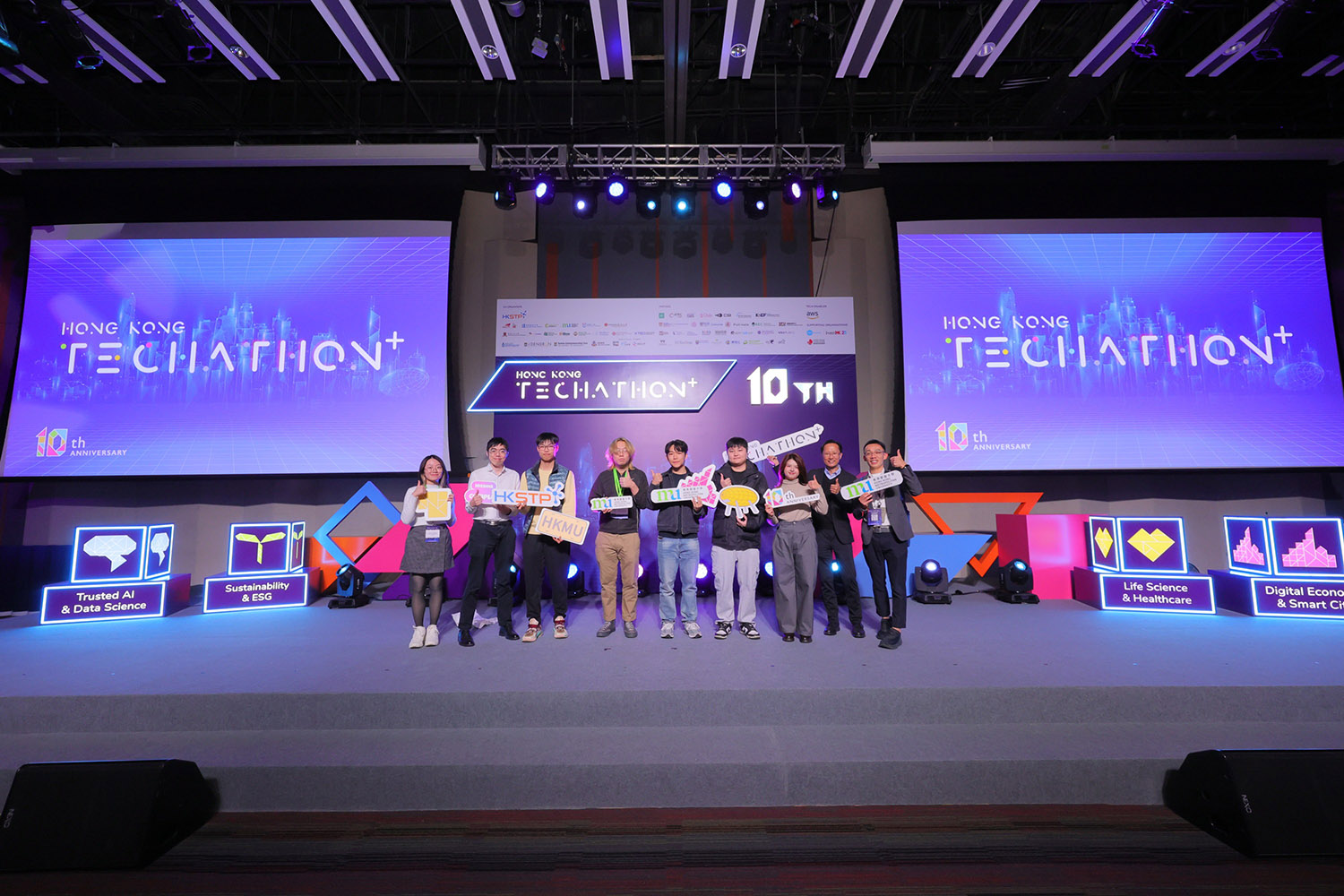
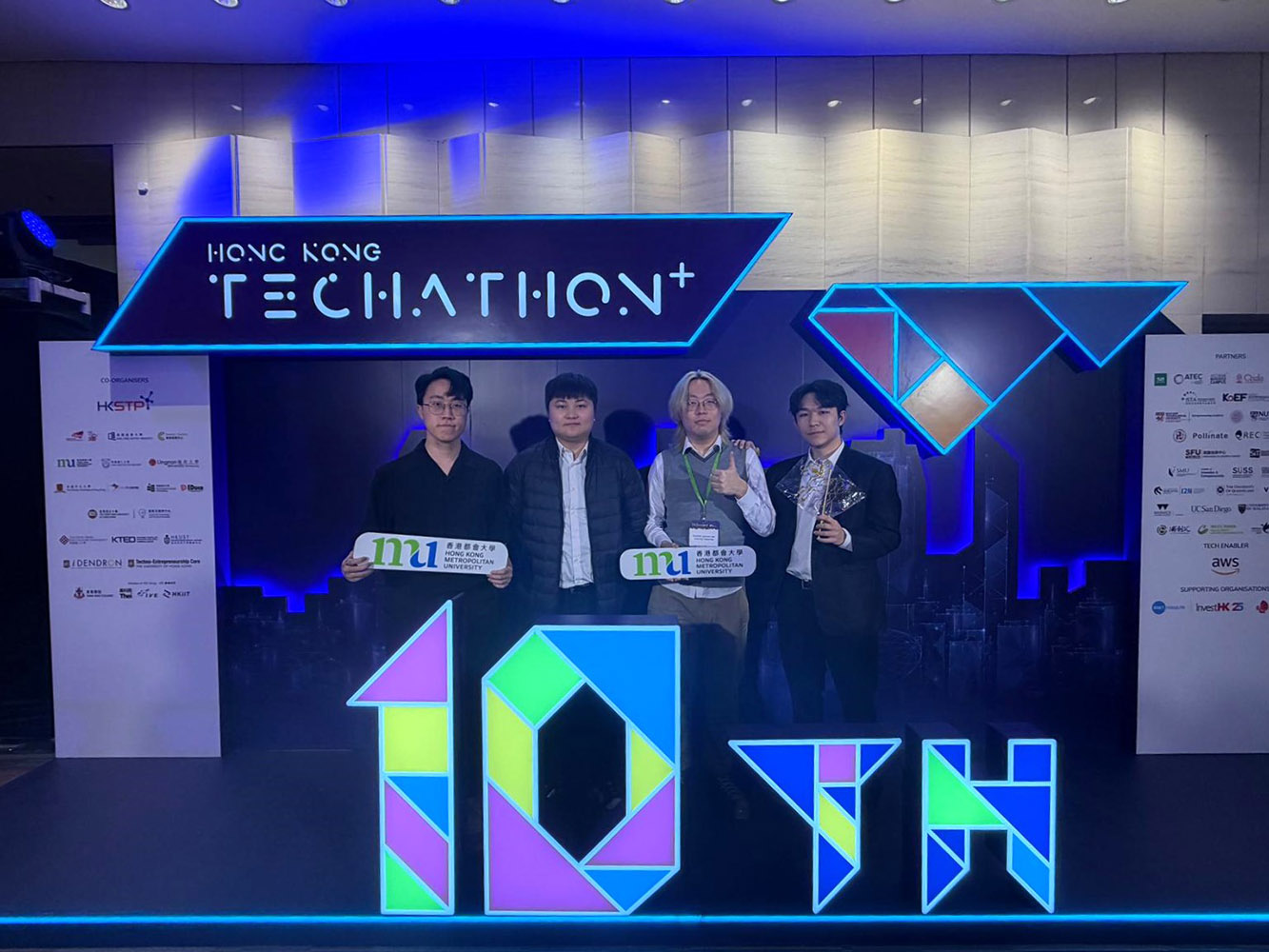
Three teams of undergraduate students from Hong Kong Metropolitan University (HKMU) received Merit Awards at the finale of the 10th Hong Kong Techathon+, the city's largest international intercollegiate innovation and technology event.
Co-organised by Hong Kong Science and Technology Parks Corporation and 15 local tertiary institutions, this year's competition attracted approximately 1,900 participants from over 470 local and overseas university teams. The event focused on four key technology themes: “Trusted AI & Data Science”, “Sustainability & ESG”, “Life Science & Healthcare” and “Digital Economy & Smart City”. Following a rigorous selection process, 172 teams advanced to the finale, held from 21 to 24 January – including six teams from HKMU, representing various tracks: the Student Group, Tech FYP Group and Open Group.
The award-winning projects are:
“OnAn Technology – Posthumous Restoration Service” (Student Group – Life Science & Healthcare)
The initiative, led by Tsui Pui-chi, a Year 2 student in Sustainable Tourism and Hospitality Management, aims to utilise 3D printing technology for facial restoration, providing dignity to the deceased and comfort to their families. Other team members include Ho Yan-tung, a Year 2 student in Sports and eSports Management.
“Subtitle glasses for hearing impaired” (Tech FYP Group – Life Science & Healthcare)
Led by Li Sin-chiu, a Year 4 Computing student, this project involves a team of fellow Year 4 Computing students – Cheng Wing-choi, Cheng Yui-wang and Zhou Wenhui – who plan to develop a wearable device with speech-to-text and sign language-to-text capabilities. Optimised for Cantonese speech recognition, the device aims to improve communication for individuals with hearing impairments.
“ResQNet – Where networks end, we begin” (Open Group – Digital Economy & Smart City)
Du Dixi, a Year 3 student in Data Science and Artificial Intelligence, and five collaborators from three other local universities, seek to address connectivity challenges in remote areas. They developed a portable network device designed to enhance access to essential networks, thereby improving safety in areas with limited connectivity.
These accomplishments reflect the University's commitment to fostering a culture of innovation and collaboration, empowering students to develop technological solutions that address community needs.