This Course Guide has been taken from the most recent presentation of the course. It would be useful for reference purposes but please note that there may be updates for the following presentation.
MGT B839
Issues in Human Resource Management
| Introduction |
 |
Welcome to MGT B839 Issues in Human Resource Management.
This course is a full-year, 10-credit post-graduate level course for OUHK students seeking a Master of Human Resource Management degree (MHRM).
The course does not pretend to be a comprehensive study of the discipline of HRM. Rather, it seeks to highlight key developments in the environment, the theory, and the practice of HRM. You, the student, are presumed to have done previous courses on the fundamentals of HRM theories and practices, and in reading this course you will be able to appreciate that managing people involves the insightful application of knowledge, skills and attitudes in an ever-changing world.
This course aims to convey the point that human issues are never static, and thus the systems for their management must also be dynamic. Line and staff managers charged with any HRM responsibility must then develop a mindset and a set of techniques appropriate to the changing realities of the workplace and larger environment. No course can cover such a mission exhaustively. Likewise, this course attempts to focus on a few current and significant HRM issues that offer sufficient scope for analysis and discussion. Such selected focus will give you ample opportunity to interface with a wide range of HRM thinking and techniques. You are encouraged to read widely beyond the selected topics to hone your sensitivity and skills towards the ever-changing HRM scenario.
The study units, readings and self-tests will help you master these topics and skills over a period of around 26 weeks.
| Course learning outcomes |
|
On completing MGT B839 Issues in Human Resource Management, you should be able to:
-
Identify and evaluate key human resource management (HRM) issues and trends both locally and globally from a strategic management perspective.
-
Critically examine the international dimension of managing human resources.
-
Apply appropriate management thinking and tools for effective HRM in a complex and changing environment.
-
Analyse and propose effective HRM measures for 'high-performance work practices'.
Purpose of this Course Guide
The Course Guide tells you briefly what the course is about and how you can work your way through the material. It suggests the amount of time you will likely need to spend in order to complete the course and will give you a general idea when your assignments are due. For detailed information on assignments, however, please refer to the Assignment File, and for information on due dates and cut-offs for work to be submitted, please refer to the Presentation Schedule.
| Course description |
|
The global business landscape has recently been reconfigured from a more straightforward north-south (or east-west, depending on whether one uses economic or cultural criteria) division into a multi-bloc system with no clear leaders and followers. The physical, economic and socio-cultural movement of people has been facilitated through globalization and all its vagaries. The pace of change has intensified. To HR managers, these new realities pose bewildering challenges as they grapple with conflicting demands, such as how to cut costs and still keep employees happy and productive.
MGT 839 Issues in Human Resource Management is designed to provide you with a framework for understanding how the environment impacts on HRM, and how HR managers can act proactively before significant changes occur. There is no prescription for sure success, but you are invited to think critically and find your own solutions according to your individual perspective on the issues featured in this course.
| Course overview |
|
The following table provides a general overview of the course structure.
| Unit |
Title |
Weeks |
Assessment
(end of unit) |
| 1 |
Challenges within HRM's dynamic macro and organizational environments, stakeholders, HRM roles and competencies |
3 |
|
| 2 |
New challenges and roles for Strategic HRM: the HR manager as strategic thinker, stress manager and peacemaker |
3 |
|
| 3 |
Managing the human side of structural change: downsizing and other consequences |
2 |
|
| 4 |
Managing performance: new trends in procuring and developing human resources |
3 |
Assignment 1 |
| 5 |
Managing performance: new trends in appraising and compensating employees |
3 |
|
| 6 |
Managing cultural diversity in organizations: demographic changes and workforce complexity |
2 |
|
| 7 |
Managing human resources globally and cross-culturally: expatriates, migrant workers and host nationals |
3 |
Assignment 2 |
| 8 |
New trends in legal aspects of employment |
3 |
|
| 9 |
Survey and research methods in HRM |
2 |
|
| 10 |
Human resources audits |
2 |
Assignment 3 |
| |
Total |
26 |
|
| Course materials |
|
In addition to this Course Guide, please note that the important course components from the OUHK include:
-
Ten study units, though you will likely receive them in three or four separate mailings.
-
The supplementary readings related to each unit.
-
Assignment File.
-
Presentation Schedule.
| Course outline |
|
There are ten units in MGT B839 Issues in Human Resource Management. Each unit consists of three to four weeks' worth of part-time work. Please remember that you have to plan your own study schedule. This is essential for you to complete your assignments on time and pass the examination. You might not receive all the study units at once.
The study units, summarize key issues, explain the relevant theories and practices, and comment on related readings. Each unit contains activities to reinforce your assimilation of the issues under discussion. Moreover, the assignments will provide you with feedback and help you achieve the objectives of the course.
The units are:
Unit 1 Challenges within HRM's dynamic macro and organizational environments, stakeholders, HRM roles and competencies
This opening unit introduces some of the HR challenges caused by turbulent external and organizational environments, the multiple stakeholder perspective and the evolving HRM roles and competencies which, together with the strategic orientation further elaborated in Unit 2, will provide a useful framework for analysis of further HRM issues in later units. In the discussion of the turbulent external and organizational environment, the issue of globalization, the threat of terrorism, economic uncertainty and managing ethics are used as illustrative examples of some of the turbulent environmental challenges. In the discussion of the multiple stakeholder perspective, the implication of stakeholders for HRM and HRM's roles in meeting the stakeholders' needs are highlighted. The unit concludes with a commentary on the importance of adopting a balanced view of the hard and soft approaches to HRM.
Unit 2 New challenges and roles for Strategic HRM: the HR manager as strategic thinker, stress manager and peacemaker
Strategic HRM was the darling of HRM scholars in the 1990s, when organizations competed vociferously for global market share. It was touted as the solution for all problems that alienated the workforce from their visionary leaders, which would not do when the enemy was 'out there'! But as the effects of globalization became more keenly felt in the new millennium, and one economic crisis after another swept across the globe, the 'S' is quietly ignored as HR managers and their bosses grapple with cost-cutting, retrenchments, and morale issues. This unit invites you to see employers and employees as business partners, 'in good times and in bad, till the economy do us part -- and beyond'. This partnership could extend into all areas of HRM, including HR planning and staffing, training and development, performance and reward management, and including separation.
Unit 3 Managing the human side of structural change: downsizing and other consequences
Unit 3 examines the impact on HRM of structural change in organizations. In the interests of increasing competitiveness or efficiency, organizations are changing with increasing speed and frequency. Mergers and acquisitions, relocations, leadership changes, new technology and other developments can cause structural change. Whether such change is dramatic US-style re-engineering, or the more gradual Japanese-style kaizen, organizations end up with new structures and management systems.
The ability of organizational members to survive such changes and work productively within the new structures is of concern to management. One immediate consequence of structural change is often the downsizing of the workforce. The 1997 Asian economic crisis -- the ripple effects of which later caught up with the rest of the interlinked business world -- showed that all organizations, whether they are 'ruthless' performance-oriented western firms or family-oriented Asian firms, are susceptible to cutting costs through trimming their workforce. Now HR managers everywhere have the unpleasant task of giving out pink slips, and of maintaining the morale and productivity of employees who survive the layoffs. Structural change also necessitates new work design, work arrangements, and work relationships, all of which fall under the HR manager's purview. It is certainly a challenge to manage such changes in the face of growing employee cynicism and insecurity.
Unit 4 Managing performance : new trends in procuring and developing human resources
An organization's culture plays a large role in job success or failure. Just like people, organizations have distinct personalities or cultures. Every organization is different in what it values, rewards and so on. Matching what the organization values and what is important to the employees can save a lot of heartache. As HR executives become more like strategic partners, they will be major players in shaping the cultures of organizations, and procurement of HR in this direction has become the trend in the US since the 1990s. It has also become the concern of HR executives in Hong Kong.
A major HRM function consists not only of training and development but also of individual career planning and development activities -- and performance appraisal, which is an activity that informs T&D needs. Training is designed to provide learners with the knowledge and skills needed for their present jobs. Development involves learning that goes beyond today's job; it has a more long-term focus. Human resource development helps individuals, groups, and the entire organization become more effective. It is essential because people, technology, jobs, and organizations are always changing.
Unit 5 Managing performance: new trends in appraising and compensating employees
This unit encourages you to think critically on the relations among compensation, incentives, and benefits. Included in the unit are discussions on the basic considerations in determining pay rates, current trends in compensation, different incentive programmes, and different benefits and services schemes. The effectiveness of various types of incentive programs as well as benefits and services schemes will be evaluated. The unit will focus on examining merit pay, which is an increasingly popular means of compensation in linking pay and performance.
Unit 6 Managing cultural diversity in organizations: demographic changes and workforce complexity
Unit 6 examines the management of a diverse workforce from a cultural perspective. Workforce diversity is a function of demographic change and deliberate management policies such as equal employment opportunity, core-periphery balance and so on. The resulting cultural and social mosaic of employees poses challenges for management that have been explored through (especially American) HRM theories. We will examine these ideas, but also assess their relevance and applicability in an Asian context.
Unit 6 also considers the concept of 'organizational culture' -- a concept that gained popularity prior to serious consideration of cultural diversity within the workforce. How can businesses develop and maintain a 'strong culture organization' at the same time as recognizing cultural diversity?
Unit 7 Managing human resources globally and cross-culturally: expatriates, migrant workers and host nationals
Unit 7 takes the diversity issue across borders. Some eminent management scholars observed that an issue in global HRM is 'that strategy (the what) is internationalizing faster than implementation (the how) and much faster than individual managers and executives themselves (the who). The challenges [therefore] are not the 'whats' of what-to-do … . They are the 'hows' of managing human resources in a global firm' (Adler and Bartholomew 1992, 52-65). You will explore the individual and systemic changes required for effective management of home, host and 'guest' workers and executives in transnational corporations. Asia, as a magnet for global investors, buccaneers and observers, is a particularly exciting context for such study. The challenge of finding effective people management strategies here is exacerbated by the diversity of cultural, political, and economic systems in the region.
Unit 8 New trends in legal aspects of employment
This unit examines the recent global trends and developments in the legal aspects of employment and labour relations, with appropriate reference to Hong Kong and the PRC. The effect of civil service reform on labour relations and trends in the changing employment status of workers will be discussed.
Throughout the unit, we will explore the implications for legislative provision and change for HR managers.
Unit 9 Survey and research methods in HRM
Unit 9 focuses on examining various methods of conducting surveys and research in the area of HRM. At the same time, it examines how the results of research in organizations can be used to help design HR programmes to satisfy employee needs and meet business goals. Various methods will be examined, including employee attitude surveys and focus groups, which are used to find out whether organizational problems exist and, if so, how they might best be resolved.
Unit 10 Human resources audits
Research findings indicate that the HR function can assist firms in sustaining competitive advantage by lowering costs, increasing productivity, and generating organization-specific knowledge and processes. Auditing the HR function is an important means of ensuring that the function is carried out both efficiently and effectively. In auditing the HR function, one has to ask what the HR function should do and what the function actually implements. 'What should be done' refers to HR's broad aims, setting out a philosophy and vision statement, and a focused mission statement. On the other hand, 'what is' deals with questions such as: What are the HR functions? How important are these functions? How well is each of the functions performed? What needs improvement? How effectively does the corporate HR function use resources? How can HR become most effective?
| Course delivery |
|
The course is structured so that each unit builds upon previous knowledge that you should have already acquired. Each unit contains various different ways to help you study. You are advised to:
-
Read the study unit.
-
Read the supplementary readings that accompany the unit.
-
Test your comprehension and analytical skills by working through the self-tests that appear throughout the unit.
-
Complete the assignments.
-
Keep in mind the key questions raised in the units as you read articles and come across relevant events and commentaries on these questions.
Textbook
There is no required textbook for MGT B839.
Reading materials
A comprehensive set of supplementary readings will be provided to support the course. Furthermore, because many of the readings are quite long, you will be guided on which key issues to focus on during your reading. You are strongly encouraged to make notes concerning these key issues as you read about them.
Assignment File
Assignment details for this course are contained in your Assignment File. The nature of these assignments is described in the 'Assignments' section below. You are required to complete your assignments and submit them through the course OLE platform by the due date specified in the Assignment File.
Presentation Schedule
The Presentation Schedule is available on the OLE. Please refer to it for planning and keeping track of your study schedule.
Internet
Links to relevant websites will be built into the study units.
Computer software
No special requirements
Equipment required by students and tutors
Web access will be very useful to search for the most up-to-date information to broaden your knowledge on the subject matter and to serve as additional resources for your assignments.
| How to work through the course material |
|
You should pay particular attention to this Course Guide and all instructions in the study units. You should also attend all your tutorials where you will meet other 'distant' learners.
Study units
You must read the study units carefully as they guide your learning and tell you how to approach any assignment related to the unit. Otherwise, you may miss important information. You must read the study units and the readings. They are not alternatives. Moreover, you should also read articles in newspapers and journals and other books related to the topics. Don't forget to scan the Web. The more widely you read, the better your appreciation and understanding of the course.
Each unit is divided into a number of sections. It introduces the materials to be covered. The next sections constitute the contents of the study unit. These sections will guide your learning and direct you to complete the self-tests and activities. The final section contains the summary of the unit and answers to the self-test activities.
Readings
You may be instructed in the study units to read articles or other supplementary materials. These will be available online or provided as hard copies at the backs of the study units.
E-Library E-Reserve readings
You may be instructed to read articles in the E-Library E-Reserve. To read these items, go to the OUHK E-Library and click on 'E-Reserve'. Log in, click 'Accept/Agree' on the Copyright Restrictions page, fill in the 'Course Code' box, and click 'Search'.
Non-assessed activities
You will come across non-assessed activities in each of the study units. These are designed to help you apply what you have learned and to prepare you for your assignments and examination. By doing these activities and referring to the suggested answers (included at the end of every unit) you can check your progress accordingly. However, you should attempt all questions before referring to the answers.
| Course assessment |
|
This course is designed to help you progress easily from the required readings to the assignments and examination. You will be required to apply the information and techniques learned during the course when doing the assignments. The assignments must be submitted to your tutor via the OLE for formal assessment in accordance with the deadlines stated in the Assignment File. The non-assessed self-test questions are not part of your formal assessment, but these should be done before progressing to the assignments.
Assignments
Three assignments have been set for this course. You must submit all assignments to your tutor for marking. It is advisable that you should also read other references, apart from the materials covered in the textbook and study units, when you are working through your assignments.
How to do your assignments
For each assignment, please read through the questions and the instructions accompanying the question in the Assignment File. Please read each question carefully and make sure you understand what is required before attempting it.
You must be careful when you are using other references in the research for your assignments. If you commit plagiarism, you will be penalized severely. Plagiarism is theft of somebody else's work or ideas. This applies just as much to using work of other students as it does to authors of books. However, you may include parenthetical references to the works you cite e.g. (Stott 1998, p. 38). So, you should include a section at the end of your assignment called 'References' where the full name, title, date and place of the publication appear. The way to cite a reference is:
Stott, V (1998) Hong Kong Company Law, 8th edn, Hong Kong: Financial Times Pitman Publishing.
How to submit assignments
You must use word processing software (such as Microsoft Word) to prepare the assignments, and submit the assignments via the Online Learning Environment (OLE). All assignments must be uploaded to the OLE by the due date.
Failure to upload an assignment in the required format to the OLE may result in the score of the assignment being adjusted to zero.
Assignment extension policy
The assignment policy of the University as stated in the Student Handbook should be observed. You are required to submit assignments for this course in accordance with the dates communicated by your course coordinator. You may apply for a submission extension on the grounds of illness, accident, disability, bereavement or other compassionate circumstances.
Applications for extensions of up to seven days should be submitted to the tutor. The tutor shall consider valid and unexpected emergencies on an individual basis. Normally, documented proof of the extenuating circumstances is not required for extensions of up to seven days. The tutor shall decide and advise you of the revised date for submission.
For extensions of over seven days, you should note the following:
-
If you require an extension of more than seven days on the grounds of illness, accident, disability, bereavement or other compassionate circumstances, they are required to complete an 'Application Form for Assignment Extension over seven days' and submit it to the Course Coordinator.
-
Supporting documents must be submitted along with the application for extension of over seven days to justify the claim.
-
Applications for extension should normally be lodged before or on the due date.
-
Applications are considered by:
- the Course Coordinator for extensions of 8 to 21 days; and
- the Dean for extensions of over 21 days.
After an assignment is submitted via the OLE, it is your responsibility to check that the assignment has been successfully submitted. Extension applications due to any problem with uploading will not be accepted. The University cannot accept any responsibility for assignments that are not received by your tutor due to any problem with submission via the OLE. As a precaution, you are advised to keep a copy of each assignment you submit.
According to the University's policy, no extension of the due date will be allowed for the final assignment. This policy will be strictly enforced. Any late submission of the final assignment will result in the score of the assignment being adjusted to zero.
Assignment schedule
| Assignment 1 is due at the end of Unit 2 and covers the contents of the first two units |
Assignment 1 |
| Assignment 2 is due at the end of Unit 5 and covers the contents of Unit 3, 4 and 5 |
Assignment 2 |
| Assignment 3 is due at the end of Unit 8 and covers the contents of Unit 6, 7 and 8 |
Assignment 3 |
Marking scheme
This tells you the total marks allocated to the assessment and to your final examination. In order to pass this course, you must pass both the assignments component and the examination.
| Assessment type |
Marks |
| Three assignments |
Assignment 1 = 10%
Assignment 2 = 15%
Assignment 3 = 15%
Total = 40% |
Examination
The three-hour examination could include a brief case (with questions) and will include essay style questions |
60% |
| Total |
100% |
Final examination and grading
The final examination for this course will be of three hours duration and count for 60% of the total course grade. You should use the time between finishing the last unit and the examination to review the entire course. You might find it useful to review your self-tests, assignments and your tutor's comments on them before sitting for the examination.
The final examination covers information from all parts of the course.
Tutors
Your assignments will be marked and commented on by your tutor, who will keep an eye on your progress and assist you if you encounter problems during the course. Marked assignments will be returned to you as soon as possible.
It is a good practice to keep copy of each assignment submitted for marking so that you can always refer to queries with the tutor during telephone conversation. Hence, please contact your tutor should any of the following arise:
-
You do not understand any part of the study units or the assigned readings.
-
You have any difficulty with self-tests.
-
You have a question or problem with the assignments, or with your tutor's comments or grading on an assignment.
Tutorials and surgeries
Apart from self-study, tutorials and surgeries will also be organized to assist you in your learning process. Details of the dates, time and location of these various face-to-face meetings as well as the name and phone number of you tutor will be sent to you in due course.
Tutorials and surgeries are organized to encourage students to take more active participation in discussions with the tutors and their fellow course mates. You will certainly find yourself benefit from each others life and work experience relevant to the content of the course.
It is strongly recommended that you attend all these meetings because they will provide considerable assistance in your study of this course. Moreover, you will have the chance to meet with other distance learners who are studying at the OUHK.
Tutors are required to start all face-to-face sessions on time. If a tutor fails to turn up 30 minutes after the scheduled starting time, students may assume that the session is cancelled and they should report the case to the Course Coordinator so that a make-up session can be arranged.
Case studies are a useful and increasingly popular form of learning and assessment in the OUHK's School of Business and Administration. In this section we will look at why case studies are used and then suggest some learning strategies that you can use to approach case studies. We will also briefly discuss some problems that you may encounter as you learn from case studies.
What is a case study approach to learning?
One main purpose of a case study is to explore an issue or a number of issues in relation to an organization. The intention is to get you to carefully diagnose an organization; to focus on key problems, and to suggest how these might be resolved. Often the case is a real-life account of an organization which you are required to analyse in order to focus on a problem. Usually, the information that is provided is incomplete and you are often expected to observe developments in the organization over a period of time. The case study approach is an excellent opportunity to actively apply material that you have read and conceptual knowledge to the reality of an organization.
At the OUHK, case studies may be used as part of assignments, exams, study units, or day-school exercises. You normally are given some information about a company (this could be both text and graphical information, such as figures and tables). You are then asked to think about some problems related to the company and to use concepts and apply theories that you have learned in your course to propose possible solutions for the company.
Let's have a look at two kinds of case study questions that you might be asked to work through in your courses. The first example is quite structured, while the second is much more open-ended.
Two examples of case study questions
- Read the case study entitled 'ABC Consultants' and consider the following issues:
- Using your understanding of the resource-based model, what measures could be taken to improve ABC's returns?
- Drawing on your broad understanding of the consultancy industry, assess ABC's relative competitiveness and its profit potential.
- To what extent do internal factors account for ABC's financial weaknesses?
- Based on your assessment of ABC's financial weaknesses, formulate a new strategic intent and develop a mission statement for ABC.
- Read the case study entitled 'XYZ Industries'.
- Identify the key problems that are currently faced by XYZ's management.
- Propose viable solutions to these problems.
Why case studies?
As you can see from the above examples, a case study approach to learning requires a great deal of thinking and often will not easily yield a quick 'wrong' or 'right' answer. However, case studies are also good preparation for dealing with real-life business problems. Cases may be short and relatively simple, or longer and complex. The purpose is the same for both types: to give you an opportunity to develop your skills in analysing the strengths and weaknesses of the organization under examination, to consider the processes at work within the organization, and to make decisions about future actions.
Case studies are not meant to replace textbooks, but rather to ask you to draw connections between theories and practice and to apply abstract ideas, concepts, and principles to specific concrete situations. Consequently, case analysis develops a number of skills that are crucial in business. In particular, they help you to:
- analyse complex, unstructured, sometimes ambiguous situations;
- identify critical issues and problems;
- question your own and others' assumptions;
- improve your problem-solving skills;
- develop your ability to find alternatives and make informed decisions;
- make decisions with incomplete information and think strategically;
- self-educate yourself and draw on a broad range of resources and knowledge; and
- present and justify recommendations in writing.
You may find that there are many possible 'right' answers to the questions in a case study. This illustrates that there is often no single best way to responsibly manage and solve real-life business problems.
Some guidelines for analysing case studies
The following strategies should help you to successfully analyse case studies:
1 Read the case and become familiar with the facts
First, skim read the case to obtain a general understanding of the main point(s). Highlight or underline the pertinent points as you read.
Read the case again, and this time note down critical facts (such as names, time sequences, and where events occurred). Try to understand how events have influenced decisions. Identify the important individuals or stakeholders, and try to assess the importance of supporting information in the case. How reliable is this supporting information? Are there any gaps in the information that is given?
Make a note of any questions that you have as you read the case.
2 Assess the context of the case
Try to understand the environment of the organization and the wider context of the case.
Ask yourself questions about:
- The state of the organization: What is the state of this organization: good, bad or in-between? Usually this involves thinking about interpersonal relationships, and assessing production or financial problems.
- Key players and systems: How do systems and people operate in this organization? Why do they operate like this? Are the systems undergoing change? How successful are the changes? Is there someone who could sabotage any future strategy? Is there someone who can ensure the success of a future strategy?
- Significant trends: How does this industry operate? What are the main or unique characteristics of the industry? What were they five or ten years ago, and what are they likely to be in the future? What impact are trends likely to have on the organization under investigation? How does this organization's performance compare with that of competitors?
- Constraints: Clearly identify all constraints in the case. A constraint may be viewed as anything (usually beyond the control of the organization) that may prevent an otherwise feasible course of action from becoming a success. What is outside the control of individuals in the case study? For example, it is unlikely that any company or individual in Hong Kong could prevent a foreign government from imposing tariff barriers on imports.
A SWOT analysis is a good way to get a better understanding of the organization and the context or environment in which it is operating.A SWOT analysis considers the Strengths and Weaknesses of the organization, and the Opportunities and Threats which the organization faces in the external environment.
3 Recognize the case's symptoms
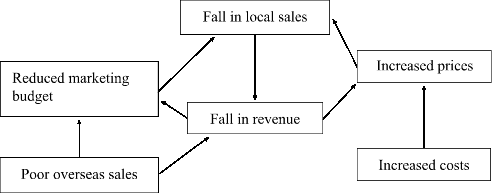
Read the case again and as you read, try listing all the symptoms of the case. The symptoms of a case are not the problems, but they may help you to identify the problems. Symptoms are all the things that are undesirable or that are not as expected. For example, falling sales could be a symptom of several problems such as poor market segmentation, poor product quality, or problems in a supply chain. At this stage of your analysis, you should just try to observe all the symptoms, and avoid prematurely identifying problems or suggesting solutions. Like a doctor who consults a patient, you first need to observe and note all the symptoms before you can give a definite diagnosis of the problem. Think about how the symptoms may be interrelated. Relationship diagrams, like the one below, may help you to see the relationships between symptoms.
4 Diagnose the case's problems
After you have a good sense of the symptoms, you're ready to determine key issues that need to be analysed more closely. You are now diagnosing the situation, like a doctor diagnosing a patient's symptoms. Ask yourself 'what seems to be the trouble in this organization?' and make a list of what you now perceive to be the key problem(s). You will probably need to go back to the details of the case and as you do this, you may add to or refine your list of potential problems.
If there are several problems, you need to order and prioritize them. You might want to number problems according to how you perceive their importance, or make a matrix, like the one below, which shows relationships between various criteria and each problem.
| Criteria |
Problem #1 |
Problem #2 |
Problem #3 |
| Importance: what will happen if the problem is not addressed? |
|
|
|
| Urgency: how quickly must this problem be solved? |
|
|
|
| Centrality: To what extent does this problem cause others? |
|
|
|
| Solvability: Can this problem actually be solved? |
|
|
|
Also try to establish if there are relationships or themes in common among the various problems. Perhaps different problems in your list are actually variations of a broader central problem.
Ask yourself what assumptions you have made about the case. Are these assumptions reasonable, and are they supported by the facts? Would other people objectively suggest the same problems, based on the facts that you have? Are you suggesting problems that are not supported by the facts of the case?
After you have considered and put into order the possible problems and questioned your assumptions relating to these problems, you should write a statement of the problems as you perceive them. Avoid suggesting solutions at this stage.
Once you have a problem statement, you need to find evidence in the case to support your problem diagnosis. Also, try to identify ideas, concepts and theories from your textbook and course units which help to explain what is happening in the case.
5 Formulate criteria for a 'good' solution and identify possible constraints to solutions
Before you propose a solution, you need to consider the characteristics of a 'good' solution. Obviously, your solution should bring benefits such as improved productivity, reduced costs or greater profits. However, it also needs to be viable and to accommodate the constraints that you have already identified, i.e. Is the solution legal? Is there a budget for this solution? Does it conflict with the organization's culture?
Try to brainstorm alternative solutions. Aim to generate a broad and creative range of options and then try to rate each according to various criteria.
The following matrix demonstrates how this can be done.
| |
Cost |
Ease of implementation |
Impact on organization culture |
Impact on profits |
| Option 1 |
*** |
* |
* |
** |
| Option 2 |
* |
*** |
*** |
** |
| Option 3 |
** |
* |
* |
*** |
Also refer to ideas, concepts and theories from your course materials as you consider and assess each possible solution.
It's often wise to propose a solution that allows for plausible alternatives if it should fail. Managers use the term satisfice when they are considering acceptable alternative solutions, that is, the solution is able to satisfy the situation while also making some realistic sacrifices to existing constraints. Therefore, it is a satisficing rather than a maximizing solution.
Finally, don't forget to consider the possibility of taking no action. What will actually happen if no action is taken? Are any (or all) of the solutions less viable than taking no action at all?
6 Recommend a viable solution
After you have assessed the merits and pitfalls of each alternative solution, select the best solution for the situation.
Remember that the solution needs to be viable. Can the recommended solution be introduced? Are there the resources and the willingness to implement it? Be realistic about what may work. Explain why it is the best solution within the constraints of the existing context and explain how it can be applied to the organization. Suggest a time-frame for the solution's implementation.
Outline possible strategies for implementing your solution, either partially or completely. As many feasible courses of action as possible should be considered before you choose the one that seems the most likely to succeed. The more ideas you have, the greater your chance will be of finding a solution that will work well. The complexity of most organizational problems means that it is highly unlikely that one idea alone will correct the situation. Usually a combination of actions is required, and these need to be funded differently, timed carefully and staffed as necessary.
7 Present your solution as a written recommendation
Review your final solutions and then prepare a set of written recommendations. These should clearly outline your proposed solution in relation to the problems that you have identified. Your recommendations should also include details of why these solutions are the most appropriate given the circumstances and constraints of the case. Finally, you need to clearly state how and when your proposals will be implemented.
Your tutor and your course Assignment File can provide some guidelines on how to present your recommendations.
Some mistakes to avoid as you analyse cases
When you first tackle case studies, you should be careful to guard against the following mistakes:
- One of the most common mistakes made in case analysis is repeating or simply summarizing the facts of the case. Your tutor is already very familiar with the case details, so you do not have to restate them. You are required to use and analyse the facts, not repeat them. Your analysis should contain only enough case material to support your arguments. Therefore, be analytical!
- You may often be tempted to just deal with symptoms and ignore the causes of the problem. It is very important to analyse the background of the case (and the climate in which the events of the case unfold).
- Avoid discussing problems in isolation and do not overlook their interrelatedness. If you try to think in terms of 'systems' rather than in terms of individual problems, you are more likely to avoid this pitfall.
- Students often fail to state the assumptions underlying their analysis. If any important assumptions have been made, have you questioned them and are they reasonable and appropriate? Avoid selectively using and interpreting case material in order to justify a preconceived solution.
- Practical limitations and constraints may sometimes be overlooked. For example, a recommendation that a whole team be fired is probably unrealistic.
- A very common mistake is poor integration of the facts in the case with the concepts, principles, and theories in the textbook. Such integration is vital. Ask yourself if relevant theories from your course have been fully and constructively applied.
- Finally, recommendations are too often not spelled out in detail or are unrealistic. A timetable for implementing them is also often not given.
Analysing cases poses many challenges, and this is one reason the case study method is so rewarding. It is a very active form of learning. It offers you a risk-free opportunity to gain managerial and organizational experience and should greatly increase your confidence to make informed decisions in the real world.
Good luck and we hope you enjoy working through the cases that you encounter!
| Summary |
|
MGT B839 Issues in Human Resource Management is intended to provide you with a sound foundation of knowledge about issues in HRM worldwide and in Hong Kong. The course includes some theory, but it also builds on your existing knowledge to advance your understanding of the selected HR issues. Hopefully you will continue to benefit from application of theories and models throughout your career as you face the unknown challenges that lie ahead.
| A note about the main course developer |
|
Barry Wilkinson is Professor of International Business at the University of Bath's School of Management, where he teaches business and management in the Asia Pacific region to undergraduate and postgraduate students. He has provided human resources consultancy services to various clients, including the International Labour Office, the Japan Management Association, the World Bank and the Korea Labour Institute.
In the mid-1980s Barry worked for three years at the National University of Singapore, and on returning to the UK he has maintained a keen interest in the East Asian region with frequent research visits to several countries. Most recently he has studied the human resources policies and practices of Asian multinationals (from Japan, Korea and Hong Kong) in Malaysia and China. Currently he is researching inter-organizational relationships in manufacturing firms in the PRC.
His research has been published extensively in academic journals and books, including the following:
The Japanization of British Industry (1992) Oxford: Blackwells (with Nick Oliver).
Working for the Japanese: the economic and social consequences of Japanese investment in Wales (1993) London: Athlone (with Jon Morris and Max Munday).
Labour and Industry in the Asia-Pacific (1994) Berlin: de Gruyter.
'The Korea labour "problem"' (1994) British Journal of Industrial Relations, 32 (3): 339-58.
'Culture, institutions and business in East Asia' (1996) Organization Studies, 17(3): 421-47.
'British factory, Japanese factory and Mexican factory: an international comparison of front line management and supervision' (2000) Journal of Management Studies, 37(4): 541-62 (with Jim Lowe and Jon Morris).
'The new international division of Labour in Asian electronics: work organization and human resources in Japan and Malaysia' (2001) Journal of Management Studies, 38(5): 675-95 (with Jos Gamble, John Humphrey, Jon Morris and Doug Anthony).
| Deferment of studies |
|
If you wish to defer your studies of this course until a later date, you should apply for deferment of studies. For the regulations governing deferment of studies, please refer to your Student Handbook. If you have applied for deferment of studies you should continue with your studies of this course and submit the required assignments until formal approval is given by the University. Should you have difficulties in submitting an assignment, you are advised to liaise with your Course Coordinator and apply for an assignment extension. Students who have been granted deferment of studies will not be allowed to submit assignments due before the date that their application for deferment of studies is received by Registry.
| About the Lee Shau Kee School of Business and Administration |
|
Click here and view the Lee Shau Kee School of Business and Administration.