This Course Guide has been taken from the most recent presentation of the course. It would be useful for reference purposes but please note that there may be updates for the following presentation.
MGT B819
Concepts and Practices of Contemporary Business Administration
| Introduction |
 |
Welcome to MGT B819 Concepts and Practices of Contemporary Business Administration, the start of a programme of study that we hope will lead to the successful completion of your MBA.
This course is a full-year, 10-credit post-graduate level course for non-business degree holders seeking a Master of Business Administration degree (MBA).
The course is intended to introduce you to the building blocks of management, which will cover a wide range of topics over the next 40 weeks but none of these will be at a level of depth that should cause you too many problems. The topics cover the normal range of managerial knowledge -- human relations, marketing, accounting and finance, operations and information. You may find that you are familiar with some of these topics if you have considerable experience or professional training in a certain field or two. If this is the case, you will be able to skim over the relevant study sessions. We doubt, however, that you will be familiar with all the material. As well as introducing functional knowledge, the course explores different managerial perspectives and encourages the development of key skills.
Throughout the course, we promote an integrative approach to contemporary business administration. We will discuss the range of stakeholders that have an interest in an organization and recognize the difficulties of reconciling these different interests. We will also introduce the value of exploring issues from a range of perspectives. Perhaps most importantly, we emphasize the need to understand and integrate the views of different functional specialists, and to this end we provide an introduction to key concepts in the important functional areas.
You should read this Course Guide thoroughly before looking at your course material. It tells you briefly what the course is about and how you can work your way through the material. It suggests the amount of time you will likely need to spend in order to complete the course, and it will give you a general idea when your assignments are due and, most importantly, information concerning the assignment submission policy. For detailed information on assignment content, however, please refer to the Assignment File, and for information on proposed study schedule, please refer to the Presentation Schedule. Finally, this Course Guide provides useful information about your final examination and grading.
| Aims |
|
The aims of this course are to provide you with a comprehensive grounding in key business disciplines, and to increase your understanding of your own role as a manager and of the context within which you perform it. It also aims to increase your knowledge of widely accepted management concepts and practices, to improve your interpersonal skills and self-awareness, and to expose you to a diverse range of managerial challenges and contexts.
| Course learning outcomes |
|
On completing this course, you should be able to:
-
Evaluate the conceptual foundations for understanding managerial, marketing, financial and operational issues in managing organizations or operations.
-
Illustrate how different disciplines contribute to more generic and integrated management.
-
Analyse the contribution of management concepts, and assess when and how they can be applied in organizations.
-
Summarize the general management problems facing organizations.
| Course description |
|
MGT B819 Concepts and Practices of Contemporary Business Administration is designed to provide you -- as a manager -- with the ability to recognize and understand the different perspectives that apply to managerial decision making and leadership. Some of these perspectives derive from an understanding of the different functions and disciplines that contribute to organizational management, i.e. a finance perspective or a marketing perspective. More important are perspectives that add value to management processes by introducing new ideas or different ways of approaching issues. The most important of these perspectives is the ability to integrate the different functional aspects of management.
There are an Introductory Unit and 10 study units in the course. Each study unit consists of three to four weeks' of part-time work. Please remember that you have to plan your own study schedule. This is essential for you to complete your assignments on time and pass the examination. You might not receive all the study units at once.
The following table provides a general overview of the course structure.
| Unit |
Title |
Weeks |
Assessment (end of unit) |
| |
Introductory Unit |
1 |
|
| 1 |
The Context and Purpose of Organizations |
4 |
|
| 2 |
Understanding Organizations |
4 |
TMA 1 |
| 3 |
Operations, Finance and Information |
3 |
|
| 4 |
Customers, Products and Quality |
4 |
|
| 5 |
Managing People |
4 |
TMA 2 |
| 6 |
Understanding and Interpreting Financial Statements |
4 |
|
| 7 |
Managerial Accounting |
4 |
TMA 3 |
| 8 |
Improving Organizational Performance |
4 |
|
| 9 |
Teamwork and Leadership |
3 |
|
| 10 |
Managing Projects |
3 |
TMA 4 |
| |
Revision |
2 |
|
| |
Total |
40 |
|
| Course materials |
|
In addition to this Course Guide, please ensure that you have the following important course components from the OUHK.
- The Introductory Unit.
- Ten study units.
- The readings related to each study unit (if applicable).
- Assignment File.
- Presentation Schedule.
Textbook
There is no required textbook for MGT B819.
Reading materials
You may find some readings at the end of each unit. Through these readings, we show how managers need to integrate the different functions or specializations that are addressed in the study sessions. We also introduce some different views and opinions on the concepts introduced in the study sessions, and we encourage you to challenge these views: critical analysis is a key management skill, and will become increasingly important as you progress through your MBA -- and your career as a manager.
Assignment File
Assignment details for this course are contained in your Assignment File. The general nature of these assignments is described in the 'Tutor-marked assignments' section below. You are required to complete your assignments and submit them to your tutor in accordance with the timetable provided in the Presentation Schedule explained below.
Presentation Schedule
The Presentation Schedule for this course is contained in your course package. It indicates how your course of study should be spread over the 40 weeks. How you manage your own study time is your decision, and the Presentation Schedule should be regarded as a guide. In the Schedule, apart from showing you the week the tutorial or day school is likely to fall in, it also shows you the due dates by which your tutor should receive your assignments.
Non-print media
Useful links
Hong Kong Government Special Administrative Region -- http://www.info.gov.hk
Hong Kong Institute of Human Resource Management -- http://www.hkihrm.org
Hong Kong Institute of Marketing -- http://www.hkim.org.hk/
The Mackinsey Quarterly -- http://www.mckinseyquarterly.com
Equipment required by students and tutors
Web access will be very useful to search for the most up-to-date information to broaden your knowledge on the subject matter and to serve as additional resources for your assignments.
| How to work through the course material |
|
Along with this Course Guide, you should have also received some study units in the same package. You should pay particular attention to this Course Guide and all instructions in the study units. You should also attend all your tutorials where you will meet other 'distant' learners.
Introductory Unit
This introductory unit is rather a short unit that requires only one week or less of study. This unit helps you to have a clearer idea of what we mean by 'management' and to appreciate the skills that managers need in order to be effective. It also helps you to be more aware of how models can help you understand situations and be able to use system ideas/diagrams for exploring complexity.
Study units
Each study unit is divided into a number of sections. The first section usually provides the overview of the unit, followed by three to five study sessions. The study sessions constitute the main body of the study unit. The final section normally contains the case study component and readings of the unit.
You must read the study units carefully as they guide your learning. Otherwise, you may miss important information. You must read the study units and the readings. They are not alternatives. Moreover, you should also read articles in newspapers and journals and other books related to the topics. Don't forget to scan the Web. The more widely you read, the better your appreciation and understanding of the course.
Non-assessed activities
You will come across non-assessed activities in each of the study sessions. These are designed to help you apply what you have learned and to prepare you for your tutor-marked assignments and examination. By doing these activities and referring to the commentary, you can check your progress accordingly. However, you should attempt all activities before referring to the commentaries.
Checking understanding
While you are doing your study, please keep in mind the objectives or learning outcomes of each study session in the unit. After you have finished the unit, please check whether you have achieved the set objectives. If you encounter any problems, please make notes and raise your concerns with your tutor as soon as possible.
Online Learning Environment
This course is supported by the Online Learning Environment (OLE). You can find the latest course information from the OLE, which also allows you to communicate with your tutor, the Course Coordinator as well as fellow students. For details about the OLE and how to access it, please refer to the Online Learning Environment User Guide.
| Tutor and tutorials |
|
You will be assigned to one of our OUHK tutors. He or she will maintain close contact with you throughout the course. Your tutor is responsible for marking your TMAs and giving you appropriate comments on what could be improved. If you encounter any difficulties during the course, let your tutor know, and I am sure that he or she will be happy to offer you some help because he or she is there to help you learn.
Do not hesitate to contact your tutor by telephone if you need help. Your tutor should be your first point of contact for any queries you may have. You will be provided with a schedule from your tutor letting you know the times when it is most convenient to call. Try to respect your tutor's wishes. However, do talk to your tutor if you need to make other arrangements. Most tutors are quite accommodating and will try to help. Remember, tutors are responsible for the grade you receive on assignments. Your tutor can help you if you have any of the following problems:
- You do not understand any part of the course material;
- You have any difficulty with study activities;
- You have a question or problem with assignments, with your tutor's comments, or grading on an assignment.
To provide further support to you, regular tutorials are organized with your assigned tutor. Tutorials provide you with an opportunity to sort out any problems. There will be regular tutorial and day school sessions designed to help you succeed in this course. You are therefore strongly recommended to attend all of them. You will be notified of their dates, times and location, together with the name and phone number of your tutor, as soon as you are allocated to a tutorial group. Remember that you should attend the scheduled tutorial and day school sessions for your assigned group only.
Tutorial policy
Tutors are required to start tutorial sessions on time. If your tutor fails to turn up 30 minutes after the scheduled starting time, you may assume that the session is cancelled and you should report the case to the Course Coordinator so that a make-up session can be arranged.
Self-help groups
You may be familiar with these study groups if you have taken other courses at OUHK. Whether you join a study group is entirely up to you.
Some good reasons for joining a self-help group:
- Sharing experience and exchanging ideas with other students.
- Allowing you to discuss the course materials with other students.
- Making this course more fun J.
However, in order to benefit from the self-help group, you have to do your homework and get yourself prepared before the meeting.
| Course assessment |
|
This course is designed to help you to move easily from the stated objectives through the required readings, activities, and assignments to a final examination. In the course assessment, you will be expected to:
- Demonstrate understanding of the concepts you have learned in the course;
- Integrate course concepts and knowledge with your own experience and observations;
- Apply course concepts and your own knowledge to case problems.
There are two major elements of formal course assessment in this course:
- Tutor-marked assignments (TMAs);
- A final examination.
| Assessment |
Course Score |
| Tutor-marked assignments (TMA 1 - TMA 4) |
4 of 4 TMAs @12.5% each = 50% of course score |
| Final Examination |
50% of course score |
| Total |
100% of course score |
Tutor-marked assignments (50%)
There are four tutor-marked assignments (TMAs) to be handed in by the due dates specified in the Assignment File. They will comprise 50 per cent of the total assessment. You will find each of these in your Assignment File along with detailed instructions on how to complete them. Please be advised that you should adhere to the word limit specified in each TMA (if applicable). You must complete all assignments and submit them to your tutor for marking in order to gain credit for this course.
After your tutor marks and comments on your assignments, they will be returned to you via the Assignment Office. Do review the comments provided by your tutor as they are meant to help you improve your performance on any remaining TMAs and on your examination.
How to submit your assignments?
You are required to complete and submit all tutor-marked assignments (TMAs) by post or by online submission (through the OLE). (See Assignment File.) All assignments must reach your tutor by the due date. You will be provided with details of your tutor's address and telephone numbers in a separate mailing.
If you are sending your TMA to your tutor by post, you should check that your tutor has received your assignment.
TMA Extension Policy
The assignment policy of the University as stated in the Student Handbook should be observed. Students are required to submit assignments for a course in accordance with the specified date. Students may apply for a submission extension on the grounds of illness, accident, disability, bereavement or other compassionate circumstances.
Applications for extension of up to seven days should be submitted to the tutor. The tutor will consider valid and unexpected emergencies on an individual basis. Normally, documented proof of the extenuating circumstances is not required for extensions of up to seven days. The tutor will decide and advise you of the revised date for submission.
For extensions of over seven days, you should note the following:
-
Assignment extensions may be granted in extenuating circumstances, which should be interpreted as circumstances that are unexpected. Work commitments and travelling are not regarded as extenuating circumstances unless they are unexpected.
-
Supporting documents must be submitted along with the application for extension of over seven days to justify the claim. Applications without supporting documents will not be considered.
-
Applications for extension should be submitted either before or on the due date.
-
The decision to grant or refuse an extension is made by:
- the Course Coordinator for extensions of up to 21 days;
- the Dean for extensions of over 21 days.
If the assignment is posted to the tutor, it is your responsibility to check that the assignment has successfully arrived. Extension applications without supporting documents on the ground of postal loss will not be accepted. The University cannot accept any responsibility for assignments that are not received by your tutor due to problems with the post. As a precaution, you are advised to keep a copy of each assignment you submit and obtain a certificate of posting from the post office when you post your assignment.
According to University policy, there is no extension to the cut-off date for the final TMA.
Final examination (50%)
At the end of the course, there will be a compulsory three-hour closed book written final examination, which will account for 50 per cent of the total course assessment. The paper will cover materials from all study units. Dictionaries are not allowed in the examination.
The examination will be comprehensive, and will include mainly essay-type questions. You have to pass the final examination in order to pass this course -- the minimum score to pass this examination is 40 out of 100. This minimum score will apply to your total TMA score too.
Remember that the final examination is comprehensive. That is, all the materials covered throughout this course may appear in the final examination. A Specimen Examination paper will be distributed to you prior to the final examination, and you can expect the final examination to have a format, not the questions, similar to the specimen one.
Final course grading
The final grade will be composed of your overall tutor-marked assignments' grade (50%) and final examination (50%). To obtain an overall pass grade, you must pass both the continuous assessment and final examination. Normally, the minimum pass mark for overall continuous assessment and final examination is 40 marks respectively. Please refer to the OUHK Students' Handbook for the details of the OUHK scale and assessment scheme.
| Use of case studies |
|
Case studies are a useful and increasingly popular form of learning and assessment in the OUHK's School of Business and Administration. In this section we will look at why case studies are used and then suggest some learning strategies that you can use to approach case studies. We will also briefly discuss some problems that you may encounter as you learn from case studies.
What is a case study approach to learning?
One main purpose of a case study is to explore an issue or a number of issues in relation to an organization. The intention is to get you to carefully diagnose an organization; to focus on key problems, and to suggest how these might be resolved. Often the case is a real-life account of an organization which you are required to analyse in order to focus on a problem. Usually, the information that is provided is incomplete and you are often expected to observe developments in the organization over a period of time. The case study approach is an excellent opportunity to actively apply material that you have read and conceptual knowledge to the reality of an organization.
At the OUHK, case studies may be used as part of TMAs, exams, study units, or day-school exercises. You normally are given some information about a company (this could be both text and graphical information, such as figures and tables). You are then asked to think about some problems related to the company and to use concepts and apply theories that you have learned in your course to propose possible solutions for the company.
Let's have a look at two kinds of case study questions that you might be asked to work through in your courses. The first example is quite structured, while the second is much more open-ended.
Two examples of case study questions
-
Read the case study entitled 'ABC Consultants' and consider the following issues:
-
Using your understanding of the resource-based model, what measures could be taken to improve ABC's returns?
-
Drawing on your broad understanding of the consultancy industry, assess ABC's relative competitiveness and its profit potential.
-
To what extent do internal factors account for ABC's financial weaknesses?
-
Based on your assessment of ABC's financial weaknesses, formulate a new strategic intent and develop a mission statement for ABC.
-
Read the case study entitled 'XYZ Industries'.
- Identify the key problems that are currently faced by XYZ's management.
- Propose viable solutions to these problems.
Why case studies?
As you can see from the above examples, a case study approach to learning requires a great deal of thinking and often will not easily yield a quick 'wrong' or 'right' answer. However, case studies are also good preparation for dealing with real-life business problems. Cases may be short and relatively simple, or longer and complex. The purpose is the same for both types: to give you an opportunity to develop your skills in analysing the strengths and weaknesses of the organization under examination, to consider the processes at work within the organization, and to make decisions about future actions.
Case studies are not meant to replace textbooks, but rather to ask you to draw connections between theories and practice and to apply abstract ideas, concepts, and principles to specific concrete situations. Consequently, case analysis develops a number of skills that are crucial in business. In particular, they help you to:
-
analyse complex, unstructured, sometimes ambiguous situations;
-
identify critical issues and problems;
-
question your own and others' assumptions;
-
improve your problem-solving skills;
-
develop your ability to find alternatives and make informed decisions;
-
make decisions with incomplete information and think strategically;
-
self-educate yourself and draw on a broad range of resources and knowledge; and
- present and justify recommendations in writing.
You may find that there are many possible 'right' answers to the questions in a case study. This illustrates that there is often no single best way to responsibly manage and solve real-life business problems.
Some guidelines for analysing case studies
The following strategies should help you to successfully analyse case studies:
1 Read the case and become familiar with the facts
First, skim read the case to obtain a general understanding of the main point(s). Highlight or underline the pertinent points as you read.
Read the case again, and this time note down critical facts (such as names, time sequences, and where events occurred). Try to understand how events have influenced decisions. Identify the important individuals or stakeholders, and try to assess the importance of supporting information in the case. How reliable is this supporting information? Are there any gaps in the information that is given?
Make a note of any questions that you have as you read the case.
2 Assess the context of the case
Try to understand the environment of the organization and the wider context of the case.
Ask yourself questions about:
-
The state of the organization: What is the state of this organization: good, bad or in-between? Usually this involves thinking about interpersonal relationships, and assessing production or financial problems.
-
Key players and systems: How do systems and people operate in this organization? Why do they operate like this? Are the systems undergoing change? How successful are the changes? Is there someone who could sabotage any future strategy? Is there someone who can ensure the success of a future strategy?
-
Significant trends: How does this industry operate? What are the main or unique characteristics of the industry? What were they five or ten years ago, and what are they likely to be in the future? What impact are trends likely to have on the organization under investigation? How does this organization's performance compare with that of competitors?
-
Constraints: Clearly identify all constraints in the case. A constraint may be viewed as anything (usually beyond the control of the organization) that may prevent an otherwise feasible course of action from becoming a success. What is outside the control of individuals in the case study? For example, it is unlikely that any company or individual in Hong Kong could prevent a foreign government from imposing tariff barriers on imports.
A SWOT analysis is a good way to get a better understanding of the organization and the context or environment in which it is operating. A SWOT analysis considers the Strengths and Weaknesses of the organization, and the Opportunities and Threats which the organization faces in the external environment.
3 Recognize the case's symptoms
Read the case again and as you read, try listing all the symptoms of the case. The symptoms of a case are not the problems, but they may help you to identify the problems. Symptoms are all the things that are undesirable or that are not as expected. For example, falling sales could be a symptom of several problems such as poor market segmentation, poor product quality, or problems in a supply chain. At this stage of your analysis, you should just try to observe all the symptoms, and avoid prematurely identifying problems or suggesting solutions. Like a doctor who consults a patient, you first need to observe and note all the symptoms before you can give a definite diagnosis of the problem. Think about how the symptoms may be interrelated. Relationship diagrams, like the one below, may help you to see the relationships between symptoms.
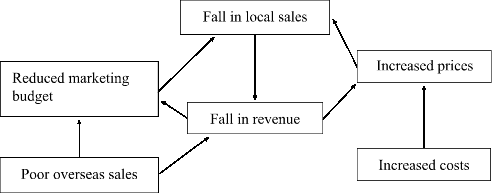
4 Diagnose the case's problems
After you have a good sense of the symptoms, you're ready to determine key issues that need to be analysed more closely. You are now diagnosing the situation, like a doctor diagnosing a patient's symptoms. Ask yourself 'what seems to be the trouble in this organization?' and make a list of what you now perceive to be the key problem(s). You will probably need to go back to the details of the case and as you do this, you may add to or refine your list of potential problems.
If there are several problems, you need to order and prioritize them. You might want to number problems according to how you perceive their importance, or make a matrix, like the one below, which shows relationships between various criteria and each problem.
| Criteria |
Problem #1 |
Problem #2 |
Problem #3 |
| Importance: what will happen if the problem is not addressed? |
|
|
|
| Urgency: how quickly must this problem be solved? |
|
|
|
| Centrality: To what extent does this problem cause others? |
|
|
|
| Solvability: Can this problem actually be solved? |
|
|
|
Also try to establish if there are relationships or themes in common among the various problems. Perhaps different problems in your list are actually variations of a broader central problem.
Ask yourself what assumptions you have made about the case. Are these assumptions reasonable, and are they supported by the facts? Would other people objectively suggest the same problems, based on the facts that you have? Are you suggesting problems that are not supported by the facts of the case?
After you have considered and put into order the possible problems and questioned your assumptions relating to these problems, you should write a statement of the problems as you perceive them. Avoid suggesting solutions at this stage.
Once you have a problem statement, you need to find evidence in the case to support your problem diagnosis. Also, try to identify ideas, concepts and theories from your textbook and course units which help to explain what is happening in the case.
5 Formulate criteria for a 'good' solution and identify possible constraints to solutions
Before you propose a solution, you need to consider the characteristics of a 'good' solution. Obviously, your solution should bring benefits such as improved productivity, reduced costs or greater profits. However, it also needs to be viable and to accommodate the constraints that you have already identified, i.e. Is the solution legal? Is there a budget for this solution? Does it conflict with the organization's culture?
Try to brainstorm alternative solutions. Aim to generate a broad and creative range of options and then try to rate each according to various criteria.
The following matrix demonstrates how this can be done.
| |
Cost
|
Ease of implementation
|
Impact on organization culture
|
Impact on profits
|
|
Option 1
|
***
|
*
|
*
|
**
|
|
Option 2
|
*
|
***
|
***
|
**
|
|
Option 3
|
**
|
*
|
*
|
***
|
Also refer to ideas, concepts and theories from your course materials as you consider and assess each possible solution.
It's often wise to propose a solution that allows for plausible alternatives if it should fail. Managers use the term satisfice when they are considering acceptable alternative solutions, that is, the solution is able to satisfy the situation while also making some realistic sacrifices to existing constraints. Therefore, it is a satisficing rather than a maximizing solution.
Finally, don't forget to consider the possibility of taking no action. What will actually happen if no action is taken? Are any (or all) of the solutions less viable than taking no action at all?
6 Recommend a viable solution
After you have assessed the merits and pitfalls of each alternative solution, select the best solution for the situation.
Remember that the solution needs to be viable. Can the recommended solution be introduced? Are there the resources and the willingness to implement it? Be realistic about what may work. Explain why it is the best solution within the constraints of the existing context and explain how it can be applied to the organization. Suggest a time-frame for the solution's implementation.
Outline possible strategies for implementing your solution, either partially or completely. As many feasible courses of action as possible should be considered before you choose the one that seems the most likely to succeed. The more ideas you have, the greater your chance will be of finding a solution that will work well. The complexity of most organizational problems means that it is highly unlikely that one idea alone will correct the situation. Usually a combination of actions is required, and these need to be funded differently, timed carefully and staffed as necessary.
7 Present your solution as a written recommendation
Review your final solutions and then prepare a set of written recommendations. These should clearly outline your proposed solution in relation to the problems that you have identified. Your recommendations should also include details of why these solutions are the most appropriate given the circumstances and constraints of the case. Finally, you need to clearly state how and when your proposals will be implemented.
Your tutor and your course Assignment File can provide some guidelines on how to present your recommendations.
Some mistakes to avoid as you analyse cases
When you first tackle case studies, you should be careful to guard against the following mistakes:
-
One of the most common mistakes made in case analysis is repeating or simply summarizing the facts of the case. Your tutor is already very familiar with the case details, so you do not have to restate them. You are required to use and analyse the facts, not repeat them. Your analysis should contain only enough case material to support your arguments. Therefore, be analytical!
-
You may often be tempted to just deal with symptoms and ignore the causes of the problem. It is very important to analyse the background of the case (and the climate in which the events of the case unfold).
-
Avoid discussing problems in isolation and do not overlook their interrelatedness. If you try to think in terms of 'systems' rather than in terms of individual problems, you are more likely to avoid this pitfall.
-
Students often fail to state the assumptions underlying their analysis. If any important assumptions have been made, have you questioned them and are they reasonable and appropriate? Avoid selectively using and interpreting case material in order to justify a preconceived solution.
-
Practical limitations and constraints may sometimes be overlooked. For example, a recommendation that a whole team be fired is probably unrealistic.
-
A very common mistake is poor integration of the facts in the case with the concepts, principles, and theories in the textbook. Such integration is vital. Ask yourself if relevant theories from your course have been fully and constructively applied.
-
Finally, recommendations are too often not spelled out in detail or are unrealistic. A timetable for implementing them is also often not given.
Analysing cases poses many challenges, and this is one reason the case study method is so rewarding. It is a very active form of learning. It offers you a risk-free opportunity to gain managerial and organizational experience and should greatly increase your confidence to make informed decisions in the real world.
Good luck and we hope you enjoy working through the cases that you encounter!
| Deferment of studies |
|
If you wish to defer your studies of this course until a later date, you should apply for deferment of studies. For the regulations governing deferment of studies, please refer to Section 14, 'Regulations for Admission, Registration and Maintenance of Status', in your Student Handbook. If you have applied for deferment of studies you should continue with your studies of this course and submit the required assignments until formal approval is given by the University. Should you have difficulties in submitting an assignment, you are advised to liaise with your Course Coordinator and apply for a TMA extension. Students who have been granted deferment of studies will not be allowed to submit TMAs due before the date that their application for deferment of studies is received by Registry.
| About the School of Lee Shau Kee Business and Administration |
|
Click here and view the Lee Shau Kee School of Business and Administration.
| Summary |
|
This is a rather long introductory document but everything important has been covered. From time to time, you will see notices and documents posted at the course Website (the OLE) to keep you up-to-date with the course.
We wish you success in this course and trust you will enjoy a challenging and inspiring learning experience.