|
The OUHK has constantly strived to ensure that our efforts reflect the changing needs of our students and our community. During the past year, we have also moved ahead with preparations for the New College, which will increase our capacity to meet the community’s growing demand for knowledge about an increasing range of subjects. We have also reviewed and adjusted the programmes we offer to match the new ‘3+3+4’ academic structure.
22 years of strength and commitment
Throughout its history, the OUHK has advanced its mission of making higher education available to all. It has built on its strengths in distance learning and developed various programmes and courses offered via the face-to-face and online modes.
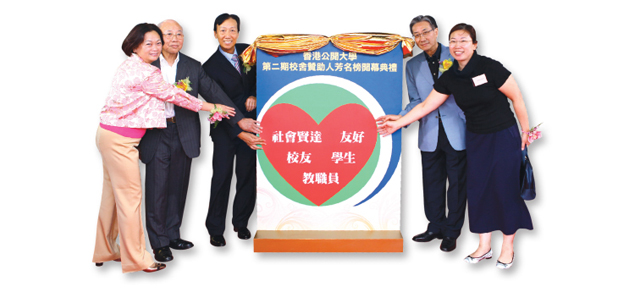
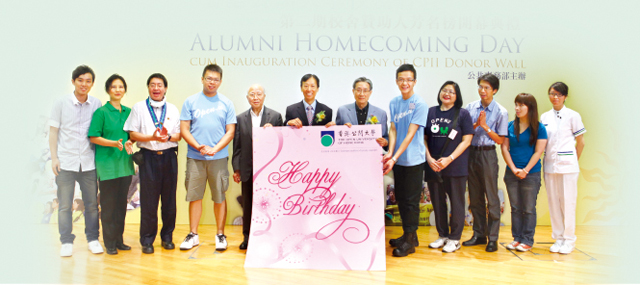
On 6 November 2011, more than 250 alumni, students, staff members and friends gathered in high spirits at the Ho Man Tin campus for the Alumni Homecoming Day cum Inauguration Ceremony of Campus Phase II Donor Wall organized by the Alumni Affairs Office to celebrate the 22nd anniversary of the OUHK.
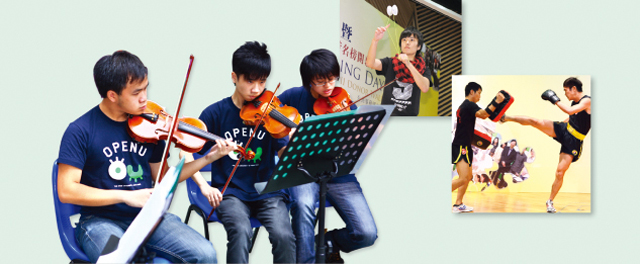
The OUHK’s Deputy Council Chairman Mr Edward Cheung, Sponsorship and Development Fund Committee Deputy Chairman Dr Vincent Woo and President Prof. John C Y Leong officiated at the ceremony. It was followed by a programme of superb performances by alumni and students that included orchestral music, songs, dances, martial arts and taekwondo displays, and yo-yo tricks. Fun and joy were the order of the day.

New College, new horizons
A combined ground-breaking and naming ceremony in February 2012 marked the start of work on the OUHK’s New College and its naming as the Jockey Club Campus. It signifies an important milestone in the development of the University and furthers our commitment to providing high quality education in Hong Kong.
Located on a site granted by the Hong Kong SAR Government on Chung Hau Street, close to our existing Ho Man Tin campus, the New College is scheduled for completion by the end of 2013. It will enrol an annual intake of 750 students and support a total student population of 2,400. In particular, it will provide opportunities for school leavers to pursue full-time programmes in the cultural and creative arts, testing and certification, and medical services programmes. These are three of the six crucial industries now being promoted by the Hong Kong SAR Government.
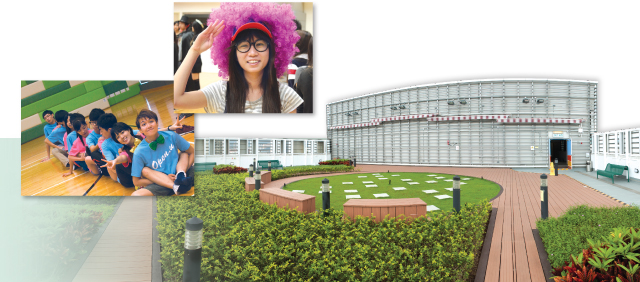
The 12-storey structure will have a total gross floor area of 21,500 square metres, and it will incorporate a number of innovative and environmentally conscious design features. Apart from teaching and learning facilities – such as classrooms, lecture theatres, a library and computer laboratories – the New College will incorporate active learning classrooms and learning commons, an auditorium, art studios and laboratories, testing and certification laboratories and enhanced nursing laboratories. A canteen and the uncovered areas of the campus will be open to public.
All set for ‘3+3+4’
The year 2012 is a landmark one for tertiary education in Hong Kong, with the introduction of the four-year bachelor’s degree programmes under the ‘3+3+4’ academic structure, admitting students based on their level of achievement in the Hong Kong Diploma of Secondary Education (HKDSE) Examination.
The OUHK is fully committed to implementing the new system. We have been a local pioneer of four-year university education since 2003, when we began to offer four-year Bachelor’s Degree programmes in the full-time face-to-face mode. With more new programmes and a broader curriculum already in place, we are well positioned for the changeover.
Building on our valuable experience, and with the support of our academic and administrative colleagues, we have reviewed and refined the curriculum of our degree programmes. We will offer four-year honours degree programmes, admitting students with HKDSE qualifications under the ‘Joint University Programmes Admissions System’.
In addition, we have consolidated and re-grouped our existing courses and their contents. Students will now pursue the major area of their studies, complemented by general education courses consisting of purpose-designed, non-discipline and English language courses.
The OUHK aims to provide graduates with a well-balanced educational experience that will combine a broad foundation and strong professional knowledge in their chosen area of specialization, together with skills to enable them to meet the challenges of an ever-changing world and satisfy society’s ever-changing expectations.
Striving for successful outcomes
Over the past few years, the OUHK has adopted an outcome-based approach to the development and delivery of our study programmes and courses. A major effort has been made to develop programme-and course-based outcomes which align with the OUHK’s institutional outcomes, which are as follows:
The OUHK expects its graduates to be able to:
• demonstrate competence academically and in related professional contexts;
• show a commitment to lifelong learning;
• think critically, analytically and creatively;
• communicate effectively;
• contribute constructively in teamwork, including playing a leadership role;
• act as responsible citizens who are ready to contribute to society; and
• adopt a global outlook and appreciate cultural diversity.
In line with the trend towards a knowledge-based society and an increasingly globalized economy, our new four-year curriculum, which is also built around the OUHK’s institutional outcomes, places greater emphasis on a well-rounded overall educational experience for students, in addition to learning specific knowledge and skills.
These outcomes align with the generic descriptors of Level 5 of the Qualifications Framework. Most of the descriptors are also consistent with the philosophy of the ‘3+3+4’ academic structure, which stresses the need to foster a broader outlook and an inclination to lifelong learning among students.
|