










School of Science and Technology 科技學院
Computing Programmes 電腦學系

UAV Rescue System

WANG Mingyang, Ashwin Sundar, LEE Tung Chak

ProgrammeBachelor of Science with Honours in Computer Science
Bachelor of Science with Honours in Internet Technology
SupervisorDr. Liu Yalin Alin
AreasIntelligent Applications
Year of Completion2026

Objectives

Project Aim

The aim of this project is to design, implement, and experimentally validate an integrated three-subsystem Smart UAV Rescue System that enables coordinated victim reporting, centralised command-and-control (C2) trajectory planning, and autonomous UAV mission execution for search-and-rescue (SAR) operations in GNSS-denied mountainous environments in Hong Kong. The system seeks to reduce dispatch latency, improve search-area coverage efficiency, and enhance operational scalability by closing the localisation gap between victim-side data and rescue-team execution.

Project Objectives
The objectives of this project include:
  1. Develop an offline-first mobile application capable of continuous trajectory logging and real-time SOS synchronisation via cloud database services under partial network conditions.
  2. Implement a centralised Ground Station C2 platform to generate spiral and grid search trajectories, manage mission states, and dispatch multi-waypoint missions via MQTT.
  3. Integrate stereo visual-inertial GNSS-denied navigation using Intel RealSense D435 and VINS-Fusion pipeline, achieving decimetre-level localisation accuracy.
  4. Incorporate EGO-Planner for real-time local trajectory optimisation and obstacle avoidance within the search radius defined by the Ground Station.
  5. Conduct system-level experimental validation to measure localisation accuracy, mission-dispatch latency, hover endurance, multi-waypoint mission success rate, and emergency-stop response time.

Videos

Demonstration Video

Presentation Video

Methodologies and Technologies used

Overall System Architecture
  • Three integrated subsystems: Mobile Application, Ground Station, and UAV.
  • Mobile app provides offline-first trajectory logging and SOS reporting.
  • Ground Station acts as centralised command-and-control (C2), generating search trajectories and dispatching missions.
  • UAV executes autonomous missions in GNSS-denied environments with local obstacle avoidance.
UAV Subsystem Design
  • Hardware: Fast-Drone-250 airframe with Intel NUC 13 Pro companion computer, RealSense D435 stereo depth camera, and Pixhawk 4 Mini flight controller.
  • Software: ROS Noetic stack integrating VINS-Fusion for GNSS-denied localisation and EGO-Planner for obstacle avoidance.
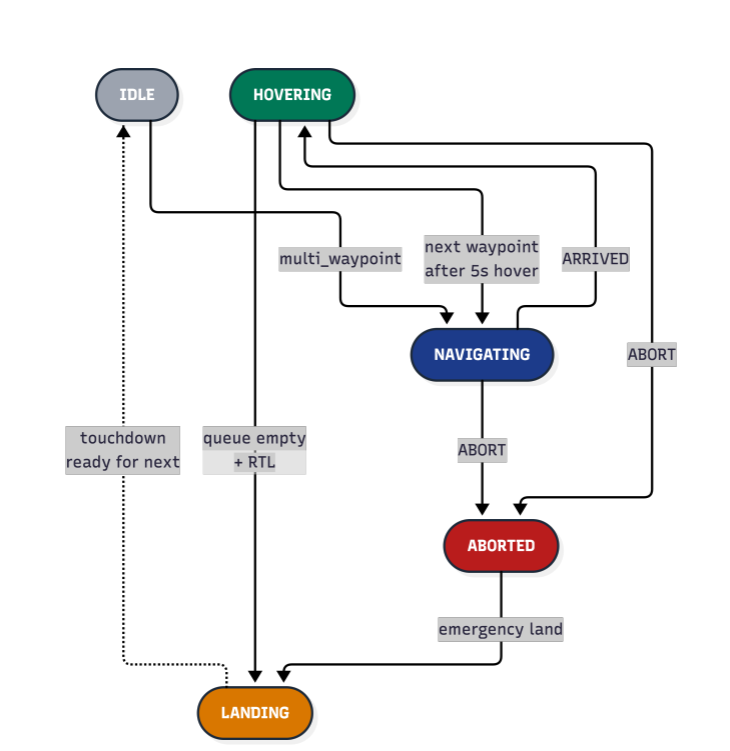
  • Mission State Machine: Implements IDLE, NAVIGATING, HOVERING, LANDING, with error paths (ABORTED, REJECTED).
  • Mission Management Layer: Handles waypoint dispatch, hover timers, and emergency-stop routines.
Mobile Application Design
  • Developed in React Native with Firebase Realtime Database integration.
  • Offline-first data layer ensures SOS and trajectory logs survive connectivity gaps.
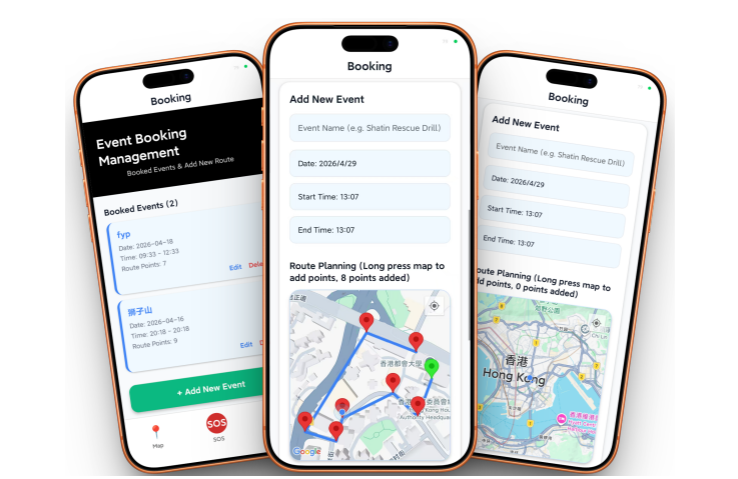
  • Features include SOS pathway, EventBooking dispatch, QuickStart mission, and trajectory logging.
  • Accessibility: Internationalisation and user-friendly interface with map-based mission planning.
Ground Station Design
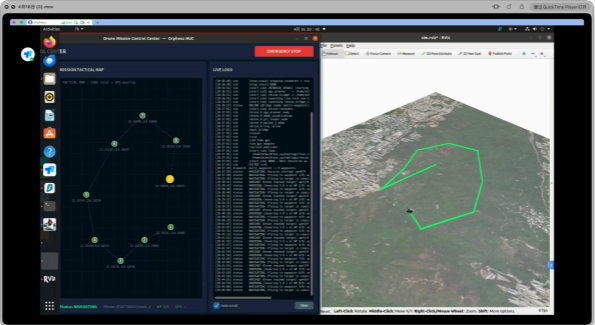
  • Centralised operator workflow with live map rendering and mission-state monitoring.
  • Generates spiral and grid search trajectories from last-known coordinates.
  • Implements MQTT-mediated mission dispatch and telemetry exchange with UAV.
  • Acts as a data mule, bridging victim-side mobile logs and UAV execution.
Communication and Data Layer
  • MQTT topic map defines mission dispatch, telemetry, and emergency-stop channels.
  • Firebase Realtime Database stores persistent victim records and mission logs.
  • Fail-safe mechanisms ensure recovery from malformed payloads, connection drops, or aborted missions.
System Integration Strategy
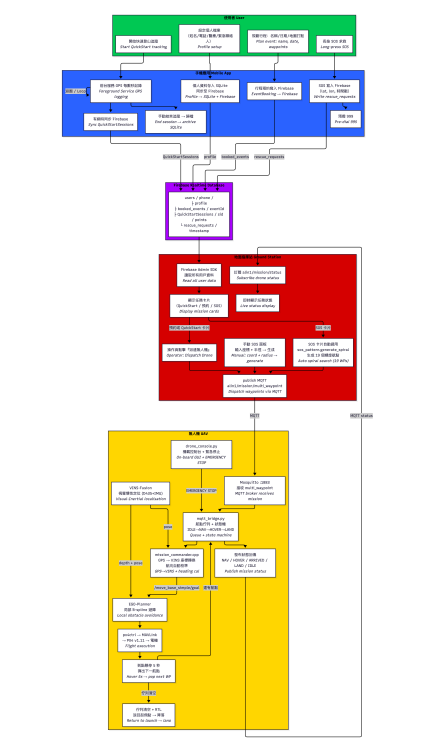
  • Subsystems integrated into a coherent pipeline: mobile reporting → Ground Station trajectory planning → UAV autonomous execution.
  • Indoor validation confirmed decimetre-level localisation accuracy and reliable obstacle avoidance.
  • End-to-end latency measured in the 80–250 ms range, with emergency-stop response below 200 ms.
Hardware Components (UAV Rescue System)
Airframe
  • Fast-Drone-250 reference platform selected as the base airframe.
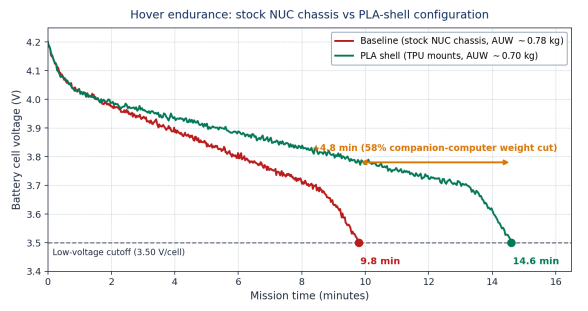
  • Lightweight PLA 3D-printed shell with TPU vibration mounts reduced companion-computer assembly weight by ~58%.
  • Hover endurance improved from ~10 minutes to ~13–16 minutes.
Companion Computer
  • Intel NUC 13 Pro (i7-1360P, 12 cores) running Ubuntu 20.04 with ROS Noetic.
  • Handles GNSS-denied localisation, trajectory optimisation, and mission-state management.
Sensors
  • Intel RealSense D435 stereo + depth camera (1–10 m range, 60 Hz) for visual-inertial odometry.
  • 200 Hz IMU tightly coupled with VINS-Fusion pipeline for decimetre-level localisation accuracy.
  • Secondary downward-facing camera dedicated to mission-path video recording for post-mission review.
Flight Controller
  • Pixhawk 4 Mini running PX4 v1.11.0 firmware (version locked).
  • Responsible for low-level flight control, take-off, landing, and emergency-stop routines.
Networking & Communication
  • MQTT protocol used for mission dispatch, telemetry, and emergency-stop communication.
  • Ground Station acts as the global trajectory planner and data mule, bridging victim-side mobile logs and UAV execution.

Figure 1: On-board mission state machine FlowChart

Figure 2: End-to-end operational flow

Results ( Prototype System Design)

Early Prototype (Direct Firebase + On-board Planning)
  • Initial design had the UAV directly query Firebase for victim records.
  • Global path-finding and trajectory generation were executed on-board alongside VINS-Fusion and EGO-Planner.
  • Feasibility validated, but companion computer was overloaded with global + local planning tasks.
  • Resulted in reduced hover endurance and higher thermal load.
Architectural Transition
  • Supervisor review (27 March 2026) led to relocating global trajectory planning to the Ground Station.
  • Ground Station became the centralised C2 authority, responsible for Firebase queries and SOS path algorithms.
  • UAV retained only local stack (VINS-Fusion + EGO-Planner) for GNSS-denied navigation and obstacle avoidance.
  • Reduced computational burden on UAV, improving endurance and responsiveness.
Comparative Testing
  • GNSS-denied localisation tested with VINS-Fusion pipeline using RealSense D435 + IMU fusion.
  • Obstacle avoidance validated with EGO-Planner achieving 95–100% success rate in cluttered environments.
  • Mission dispatch latency measured at 80–250 ms; emergency-stop response below 200 ms.
  • Hover endurance improved from ~10 minutes to ~13–16 minutes after hardware weight reduction.
Final Prototype Stack
  • Mobile Application: Offline-first React Native app with Firebase Realtime Database integration.
  • Ground Station: Operator interface with spiral/grid trajectory generators, MQTT dispatch, and mission-state monitoring.
  • UAV Subsystem: Intel NUC companion computer running ROS Noetic, RealSense D435 for localisation, Pixhawk 4 Mini for flight control.
  • Communication Layer: MQTT-mediated mission dispatch and telemetry exchange; Ground Station acts as data mule.
  • Outcome: Integrated three-subsystem architecture delivering network-resilient reporting, centralised planning, and autonomous execution.

Figure 3. UNC-Side Execution

Testing Result
UAV Performance Evaluation
  • Hover endurance improved from ~10 minutes to ~13–16 minutes after reducing companion-computer assembly weight by ~58%.
  • Flight-controller responsiveness validated with reliable take-off, landing, and emergency-stop routines.
  • GNSS-denied localisation achieved decimetre-level accuracy (0.10–0.30 m RMSE) using VINS-Fusion pipeline with RealSense D435 + IMU fusion.
  • EGO-Planner obstacle avoidance success rate measured at 95–100% in moderately cluttered environments.
Communication Reliability
  • Mission-dispatch latency measured in the 80–250 ms range.
  • Round-trip MQTT latency confirmed stable across payload sizes.
  • Emergency-stop response consistently below 200 ms, ensuring safe human-in-the-loop control.
Mobile Application Performance
  • Trajectory logging and SOS pathway tested under intermittent connectivity; logs synchronised successfully once network was restored.
  • EventBooking and QuickStart dispatch features validated with multi-waypoint mission planning.
  • Offline-first design ensured victim-side data survived network blind spots.
Ground Station Evaluation
  • Cold start and map rendering performed reliably with live mission-state monitoring.
  • Spiral and grid trajectory generators produced reproducible search patterns from last-known coordinates.
  • Connection stability maintained during extended mission dispatch and telemetry exchange.
End-to-End System Validation
  • Use Case 1 (SOS Dispatch): Generated spiral search mission from victim's last-known coordinate; UAV executed autonomously.
  • Use Case 2 (EventBooking Dispatch): Operator created structured multi-waypoint route plan; UAV completed mission successfully.
  • Use Case 3 (QuickStart Dispatch): Immediate launch with default parameters validated rapid response capability.
  • Failure-mode recovery tested; system returned to safe state under abort conditions.

Figure 4. Hover-endurance comparison

Figure 4. EventBooking screens

Implementation

Deployment Hardware (UAV Subsystem)
  • Device: Fast-Drone-250 airframe with Intel NUC 13 Pro companion computer.
  • Operating System: Ubuntu 20.04 running ROS Noetic for GNSS-denied navigation tasks.
  • Processor: Intel i7-1360P, 12-core CPU handling localisation and mission-state management.
  • Memory: Companion computer supported by lightweight PLA shell, reducing assembly weight by ~58%.
  • Sensors: Intel RealSense D435 stereo + depth camera (1–10 m, 60 Hz) tightly coupled with 200 Hz IMU.
  • Flight Controller: Pixhawk 4 Mini running PX4 v1.11.0 firmware (locked version).
  • Networking: MQTT protocol for mission dispatch, telemetry, and emergency-stop communication.
Final System Workflow
  • Connection: Mobile app sends SOS/trajectory logs to Firebase; Ground Station retrieves and generates search patterns.
  • Mission Dispatch: Ground Station publishes multi-waypoint missions via MQTT to UAV.
  • Local Execution: UAV executes waypoints autonomously using VINS-Fusion localisation and EGO-Planner obstacle avoidance.
  • Telemetry: UAV streams mission-state updates back to Ground Station for operator monitoring.
  • Output: Rescue teams receive structured search coverage, trajectory logs, and mission-path video recordings.

Conclusion

Summary of Achievements
  • Designed and validated a three-subsystem Smart UAV Rescue System integrating Mobile Application, Ground Station, and UAV.
  • Mobile app provided offline-first trajectory logging and SOS reporting, ensuring victim data survived connectivity gaps.
  • Ground Station successfully generated spiral and grid search trajectories, dispatched missions via MQTT, and acted as a data mule.
  • UAV subsystem achieved decimetre-level localisation accuracy using VINS-Fusion and reliable obstacle avoidance with EGO-Planner.
  • Hover endurance improved from ~10 minutes to ~13–16 minutes through hardware weight optimisation.
  • End-to-end mission dispatch latency measured at 80–250 ms, with emergency-stop response below 200 ms.
System Integration
  • Relocated global trajectory planning from UAV to Ground Station, reducing computational burden and improving endurance.
  • Integrated Firebase Realtime Database for persistent victim records and mission logs.
  • Implemented MQTT-mediated communication for reliable mission dispatch and telemetry exchange.
  • Validated complete pipeline: victim-side mobile reporting → Ground Station trajectory generation → UAV autonomous execution.
Limitations
  • Testing was primarily indoor and simulation-based; large-scale outdoor SAR deployment remains unvalidated.
  • No physical Wi-Fi data-mule handshake implemented; current design relies on software-based data relay.
  • AI-assisted victim detection not yet integrated; UAV acted as executor rather than detection platform.
Future Work
  • Extend to outdoor field trials in Hong Kong country parks under real SAR conditions.
  • Implement physical phone-to-drone Wi-Fi handshake for direct victim data extraction.
  • Develop multi-UAV scheduling and swarm coordination for larger search areas.
  • Integrate AI-assisted visual victim detection to enhance UAV autonomy.

Future Development

System Expansion
  • Extend experimental validation from indoor and simulation environments to full-scale outdoor trials in Hong Kong country parks.
  • Implement physical Wi-Fi data-mule handshake between victim devices and UAV for direct data extraction.
  • Develop multi-UAV scheduling and swarm coordination to expand search coverage and reduce mission time.
AI-Assisted Detection
  • Integrate computer vision models for real-time victim detection during UAV missions.
  • Combine GNSS-denied localisation with AI-based image recognition to improve search efficiency.
  • Explore multi-modal fusion of visual, thermal, and acoustic inputs for robust detection in diverse terrain and weather conditions.
Communication & Reliability Enhancements
  • Further optimise MQTT-based communication for lower latency and higher resilience under poor connectivity.
  • Expand fail-safe mechanisms to cover additional failure modes, including prolonged network outages and UAV hardware faults.
  • Investigate adaptive resource management scripts to balance performance and battery efficiency across UAV missions.
Operational Integration
  • Collaborate with Hong Kong SAR authorities to align system workflows with existing rescue protocols.
  • Integrate the mobile application with HKSOS and other emergency-reporting platforms for broader adoption.
  • Conduct user training and interface refinement based on operator feedback during live demonstrations.