Testing Result
Hardware Testing
The hardware goggles were tested for comfort, safety, clarity, stability, control, and punctuality. Comfort trials confirmed the weight was manageable, with adjustments made for different facial structures. Safety checks ensured attachments were secure and lighting was non-glare. Clarity tests showed the macro camera captured clear pupil images under supplemental lighting. Stability confirmed reliable Raspberry Pi–app connections. Control verified power consumption and heat were manageable with proper ventilation. Punctuality tests showed data transmission times under one second. Overall, the goggles emitted Wi-Fi stably, processed commands rapidly, and were safe and comfortable to use.
Application Testing
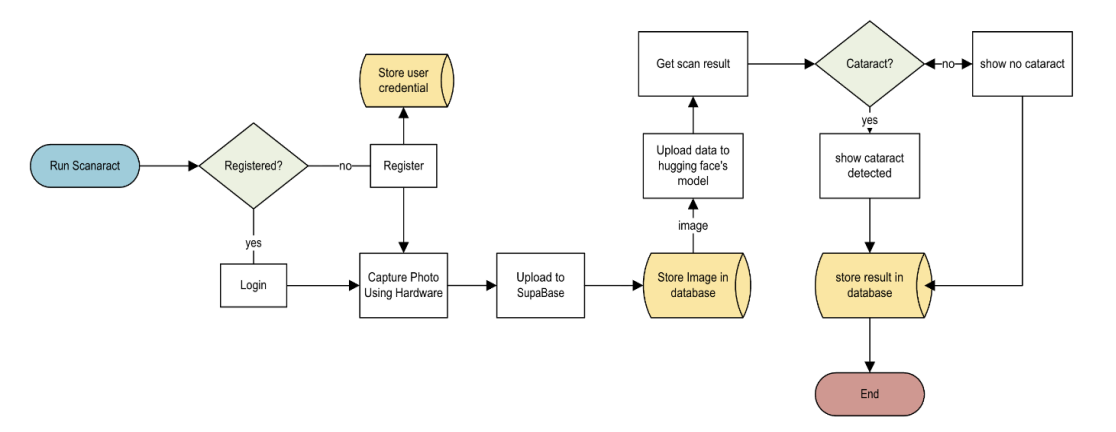
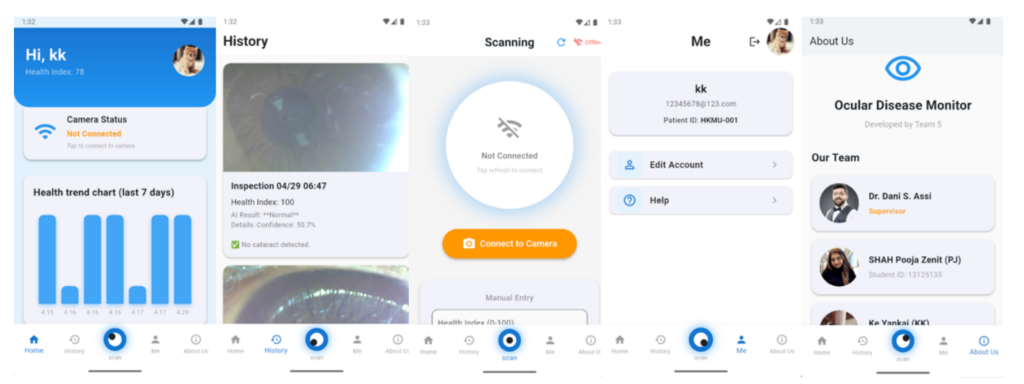
The Flutter-based app was tested across Android, iOS, and desktop browsers. System-specific permissions were verified to ensure functions worked without crashes or freezes. User interface testing confirmed smooth transitions, consistent fonts, correct image ratios, and responsive feedback. Backend testing optimized response speed. Communication protocols were validated for LAN and cloud interactions, with delay tolerances set for different devices. Cloud response times were tested along the full workflow path and remained within tolerance. Illegal input handling, gesture animations, reconnection mechanisms, program interruption resilience, API call monitoring, data consistency, encryption, and server crash recovery were all tested successfully. The app demonstrated secure data handling, seamless cross-platform performance, and reliable communication protocols.
Database Testing
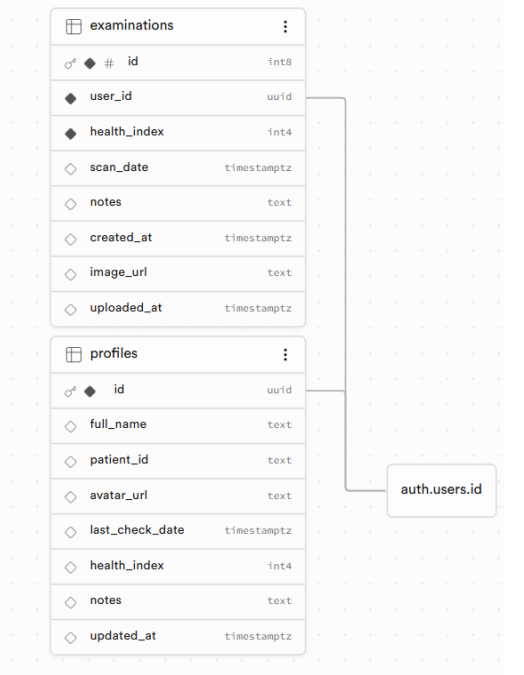
Supabase PostgreSQL and Storage were tested for connection stability, data structure integrity, and multi-user requests. The database consistently added information quickly, maintained correct structures, and handled simultaneous user requests seamlessly. UUID keys, cascade deletes, and security policies ensured reliable and secure data management.
Computer Vision Model Testing
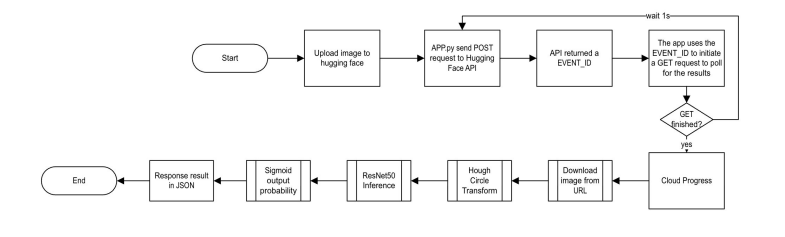
The CV model was tested for accuracy, precision, recall, and deployment. Fine-tuned models achieved expected accuracy, precision, and recall on unseen test photos. Deployment to HuggingFace was successful, with responses returned within 45 seconds. The model performed well with hardware conditions and correctly predicted cataracts in a real patient test (without goggles). Overall, the CV model demonstrated reliable diagnostic performance.
AI Accuracy Evaluation
ViT Hybrid Model
Initial evaluations showed ViT outperforming DenseNet121 on open-source datasets. However, hardware-acquired images revealed poor robustness in the baseline ViT. The team improved the ViT while also enhancing ResNet50. The hybrid ViT achieved higher accuracy than the baseline, with hyperparameters including input size 224×224, batch size 16, optimizer Adam, CrossEntropyLoss, learning rates 5e-5/5e-6, attention regularization λ=0.2, margin=0.05, and staged training (10 + 15 epochs).
ResNet50 Model
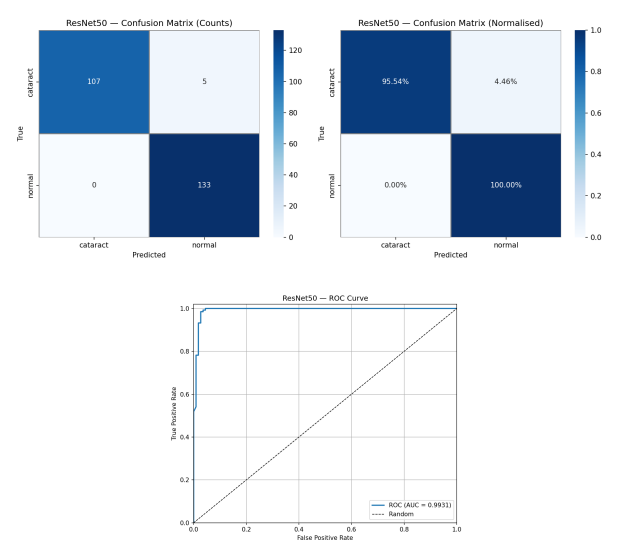
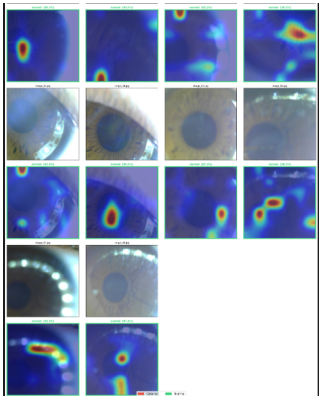
ResNet50 achieved high sensitivity and specificity, with AUC-ROC >0.98 and strong confusion matrix results. Grad-CAM visualizations confirmed the model focused on the crystalline lens, ensuring clinical interpretability. Statistical metrics demonstrated excellent true positive rates and reliable generalization across validation sets.
Model Comparison
Final comparison showed ViT Hybrid (Accuracy 99.7%, Precision 99.67%, Recall 99.67%) versus ResNet50 (Accuracy 100%, Precision 100%, Recall 95.54%). Given the priority of recall in medicine, ResNet50 was selected as the final model for Scanaract.