 |
 |
 |
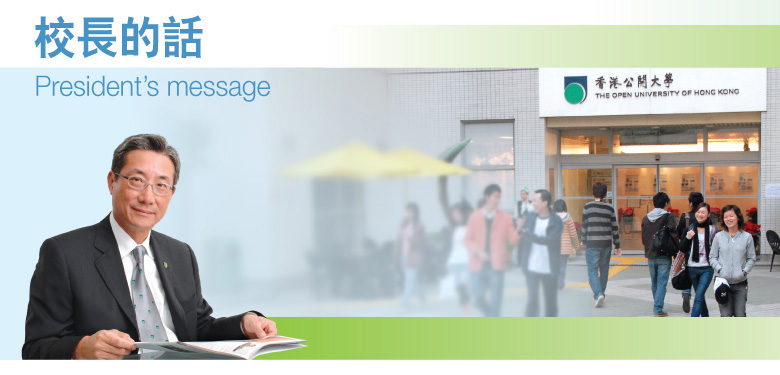
The OUHK's fund-raising efforts met with tremendous success last year, most notably in the Government Matching Grant Scheme, which was set up to encourage local tertiary institutions to get more donations from the community. The Scheme was extended to the OUHK last year and so we could benefit from it for the first time, together with tertiary institutions directly subsidized by the Government. As a financially independent public university, the matched grant and donations, totalling $160 million, will clearly bring major benefits to the OUHK's development. We are most indebted to all the alumni, staff, students and friends in the community who have supported us again at this critical juncture.
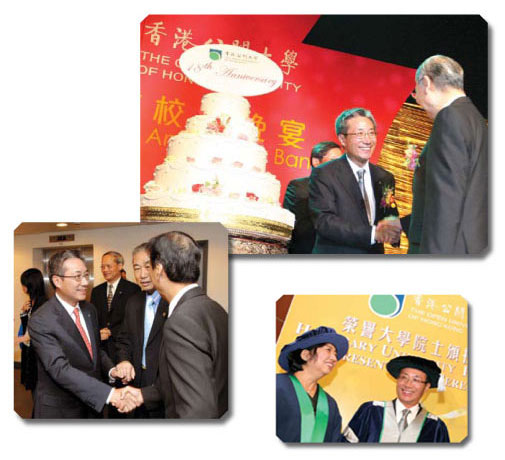
We shall make the best use of this additional fund to seek breakthroughs in teaching pedagogy through innovative technologies, offer a wider spectrum of courses, strengthen our academic endeavours and boost our student assistance. Part of the money will be used to offset some of the construction cost of Campus Phase II.

Thanks to the sponsorship of business leaders such as Dr Lee Shau-kee and Dr Cheng Yu-tung, who donated $50 million and $35 million respectively to the OUHK during the year for general and campus development, the University will be able to plan for more long-range projects and undertakings, such as those for our expanding full-time student population.
Since launching full-time programmes in response to the Government's call in 2001, the OUHK has been providing much-needed further study opportunities for school- leavers. Our top-up degree programmes have also helped many associate degree graduates to gain recognized university qualifications. The OUHK welcomes the Education Bureau's recent announcement that it will allocate low-interest loans for associate degree graduates to move to degree level. We are open to discussion on how to turn this new policy into concrete action, so that more students can benefit from the University's rigorous standards and quality curricula.
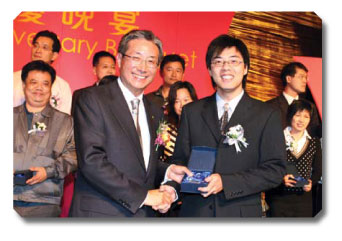
While the introduction in 2009 of the 3+3+4 system – where students study for three years at junior secondary school, three years at senior secondary school and four years at university – is likely to lead to a surge in demand for university places, the Government's support for the establishment of private universities may encourage more institutions to offer more full-time self-financed degree and top-up degree programmes. We will have to review our programmes and curriculum structure continuously and stay alert to the needs of students and society if we are to further enhance our position in full-time education provision.
The Government's plan to develop Hong Kong into an international education hub has our firm backing, and we have taken some small steps in this direction by enrolling a limited number of mainland China and foreign students in our full-time studies. Last year we had over 500 applications from mainland students, but could only offer 31 places because of the lack of a dormitory. We hope it will not be long before the proposal of building communal dormitories can be turned into action.
We shall continue to seek entry into the University Grants Committee, which mediates policies for all publicly-funded local institutions. Although our admission into the Committee may not bring any Government funding support, we believe it will strengthen the OUHK's position and contribution to higher education provision and policy formulation at large, especially in non-traditional course delivery and credit transfer mechanisms.
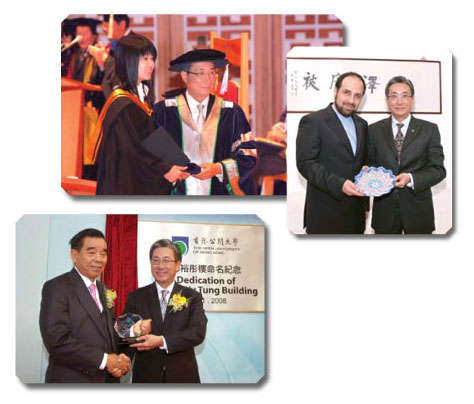
Notwithstanding our progress in the development of full-time programmes with some entry requirements, the OUHK is committed to our founding principle of providing open education to all, regardless of previous educational background and qualification. In order to fulfil this mission in the 21st century, when the advances in technology have made available numerous exciting modes and means of teaching and learning, the OUHK has taken a positive stance towards these changing trends.
During the year we set up a Centre for Innovation to examine how to synthesize the best elements of distance learning, face-to-face teaching and online learning, so as to further enhance the learning environment and support services for students. Free online courseware units, drawn from a wide range of the OUHK's course materials, have been introduced to the public to promote academic pursuits and give them a taste of our distance learning. Also, a totally online programme was launched by the newly established Centre for eLearning, and has received very favourable feedback from students.
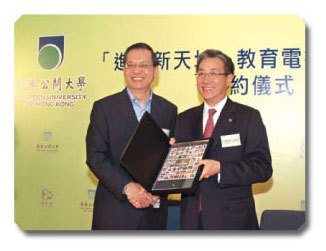
The online programme, at postgraduate level, was the first of its kind around the world in the subject area of Chinese Business Law. Another programme which started enrolment last year, a Diploma in Early Childhood Education, was also well received. Later this year the OUHK will introduce a Master of Arts in Legal Translation and a Master of Education in Drama and Language Education, as well as undergraduate programmes in beauty and health, energy and environment, and creative writing and film arts. In addition, the University concluded an agreement with a university in mainland China to offer jointly a full-time Bachelor of Arts (Hons) in Language and Translation programme. The OUHK will continue to monitor closely and respond quickly to the education and training needs of society.
As we move from the information age to the conceptual age in the globalized world of the 21st century, traditional pedagogies are fast being replaced with new innovations and creative ideas. Like all educational institutions, the OUHK will face many uncertainties and challenges but also new exciting possibilities that were unthinkable in the past. The University will continue to explore and tap into these possibilities so that more individuals can enrich their lives and fulfil their potential through quality, innovative and flexible education.


Copyright (C) The Open University of Hong Kong 2008.