 |
 |
 |
As the momentum of globalization gathers pace, Hong Kong is inevitably affected by fluctuations in world economic conditions in an increasingly interdependent network of national and transnational economies. While the impact of periodic volatility and aberrations in the financial markets may be short-term, the world trend of shifting production to low-cost countries and regions has continued unabated. The resulting decline in manufacturing jobs in developed countries is inevitable and irreversible. Against this background, Hong Kong has seen a reduction in the number of blue-collar workers from more than one million 30 years ago to less than 200,000 today. Few people would disagree that to maintain our prosperity and advantage, Hong Kong must turn to high value-added exports and services, relying on innovation, and a highly educated workforce. Raising education standards and enhancing the competence and productivity of our population is the only way forward. Since the early days, high-quality human r esources have always been the most valuable asset of our society. The best safeguard against the impact of economic challenges is to maintain our competitiveness through providing and encouraging people to take up lifelong learning opportunities.
The OUHK has played a significant role in improving the quality of Hong Kong’s human capital. Its open access and flexible mode of learning meet the pressing need of tens of thousands of working adults to upgrade themselves, especially those who were left out of the highly selective tertiary education system of the last century. In the last 18 years, over 140,000 people from a variety of backgrounds and age groups have benefited from this alternative route of part-time education. Last year alone saw the addition of over 5,500 graduates. These adults managed to overcome many barriers and challenges to pass demanding assessments and acquire career and professional qualifications which are widely accepted as hallmarks of quality and competence. Embedded in their awards is a spirit of tenacity, maturity and excellent ability to balance competing demands. It is no wonder that OUHK graduates are among those eagerly sought after by businesses and other employers.

The University’s efforts to develop a more diverse and flexible system have reaped a rich harvest. Full-time degree programmes have thrived since 2001, reaching a new high of 3,000 students this year. Many associate degree graduates are taking advantage of our credit transfer arrangements and multiple entry and exit pathways to complete their studies for a bachelor’s degree. The University has also made some inroads in part-time face-to-face teaching a nd e-learning to meet the needs of particular groups of learners.
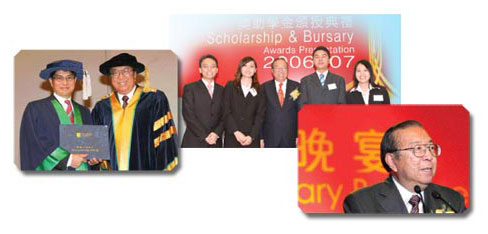
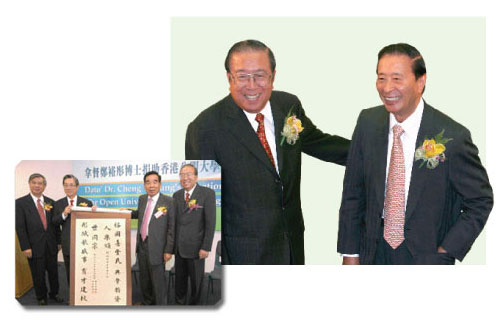
As a financially independent university, the OUHK does not receive any Government subsidies for its recurrent expenditure. It fulfils its mission of providing tens of thousands of places for higher education through astute and efficient financial management based on fees, contributions and endowments. Moreover, the University firmly believes in the importance of mobilizing the community to provide a supportive learning environment for students. We are most grateful to many long-standing friends who have rendered us admirable assistance in many fields, especially in student aid, academic exchange and capital expansion projects. We are most heartened that recent calls for donations towards the Government Matching Grant Scheme and campus development have been a resounding success, with generous gifts from many new friends and community leaders.
The OUHK is an exemplary model, and perhaps the answer to the conundrum of expanding higher education without upsetting the delicate balance of access, cost and quality. As Hong Kong continues to explore more equitable, affordable and viable means of providing tertiary education places, such as the much debated community colleges and private universities, the OUHK marches on with unswerving determination towards its 20th anniversary, ready to play an even greater role in cost-effective, excellence-oriented, and yet quality-assured, higher education. To be able to accomplish this, we owe much to our dedicated staff, sound financial sense and shrewd management, which have enabled us to build a very firm foundation for the flourishing of open education in Hong Kong.


Copyright (C) The Open University of Hong Kong 2008. 版權所有 不得轉載