Master of Science in Medical Laboratory Science (MSCMLSF)

School of Science and Technology Programmes Department of Applied Science Master of Science in Medical Laboratory Science (MSCMLSF)

Master of Science in Medical Laboratory Science (MSCMLSF)

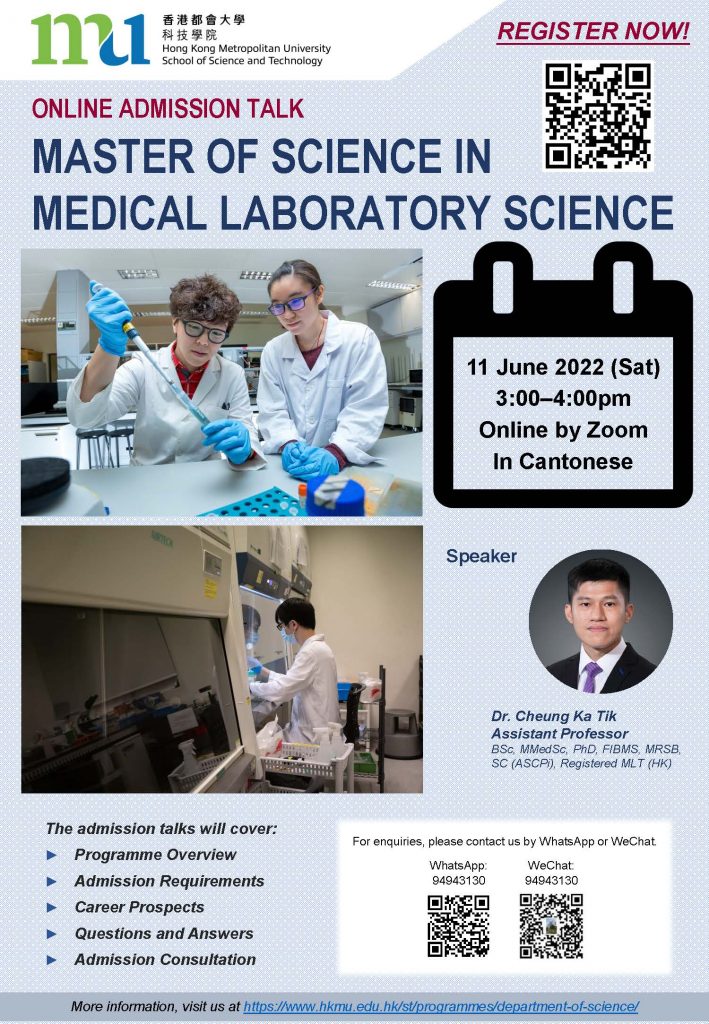
Online Admission Talk of MSc in Medical Laboratory Science

Date: 11 June 2022 (Saturday)


Time: 3:00pm – 4:00pm


Medium: Online by Zoom


Language: Cantonese


Content:     

1. Programme Overview
2. Admission Requirements
3. Career Prospects
4. Questions and Answers
5. Admission Consultation


Registration Link: https://forms.gle/kfeSDt8o3WmzW4U66

All undergraduate students and practitioners in biomedical science/ medical laboratory science/ related health sciences/ applied sciences are welcome. Prior registration is required. The Zoom meeting ID and password will be sent to your email after the registration.

Programme code :MSCMLSF
Type of programme/ Mode of study:Full-time and Part-time Master's Degree Programme
Medium of instruction:English

Entry Requirements

Students admitted to the programmes should have

  • A Bachelor’s Degree in Biomedical Science, Medical Laboratory Science, or a related health sciences or applied sciences discipline (e.g. Life Sciences and Biological Science) from a recognized institution or equivalent qualification.
  • Applicants must meet the English language proficiency requirements set by HKMU (DSE, TOEFL, IELTS, CET-6, etc., details showed in Appendix A) if their Bachelor's Degrees or equivalent qualification did not adopt English as the medium of instruction.
Proficiency Test
Minimum score
English Language Subject of the Hong Kong Diploma of Secondary Education Examination (DSE)
Level 3
TOEFL – paper-based
550
TOEFL – paper delivered
60 (total scores for Reading, Listening and Writing sections)
TOEFL – internet based
79
IELTS
6.0
CET-6
430
*Shortlisted applicants will be invited to attend a (face-to-face or online) admission interview after submitting applications. Applicant must have passed the admission interview for successful application.

Programme Aims

This programme provides students with critical knowledge and understanding of the theoretical and practical aspects of specialist disciplines such as haematology and transfusion science, chemical pathology, medical microbiology, molecular biology, anatomical and cellular pathology, pathology, immunology, and the integration of these disciplines for use in medical laboratory science.

Programme Structure

Students are required to complete a totally 33 credits from compulsory, core electives and laboratory-based dissertation.

Courses Lists for MSCMLSF

Course CodeCourse TitleCredit Units
Compulsory Courses (6 credit units)
SCI 8021SEFMolecular Diagnostic Technology3
SCI 8022SEFFrontiers in Medical Laboratory Sciences 3
Core Elective (Any 18 credit units from the list below)
SCI 8001SEFClinical Chemistry & Immunology I3
SCI 8002SEFClinical Chemistry & Immunology II3
SCI 8003SEFHaematology & Transfusion Science I3
SCI 8004SEFHaematology & Transfusion Science II3
SCI 8005SEFHistopathology & Cytology I3
SCI 8006SEFHistopathology & Cytology II3
SCI 8007SEFMedical Microbiology & Virology I3
SCI 8008SEFMedical Microbiology & Virology II3
SCI 8009SEFIntegrated Medical Laboratory Science3
SCI 8010SEFScientific Research Methodologies6
SCI 8023SEFLaboratory Management and Accreditation3
Project (9 credit units)
SCI 8029SEFDissertation in Medical Laboratory Science9

Teaching and Learning

Students will learn through full-time or part-time face-to-face mode with online support. Regular face-to-face lectures and tutorials are available in all the prescribed courses except dissertation course SCI 8029SEF. Workshops, visits or laboratory sessions are available in some courses as well. These face-to-face sessions aim to provide opportunities for students to discuss academic issues with their lecturers and acquire practical laboratory skills. All the prescribed courses will also be supported by the HKMU Online Learning Environment (OLE) which provides online discussion for interaction among students and between lecturers and students. This allows discussion of theories explained in the courses, their applications and evaluations.

Career Prospects

The programme allows suitably qualified science graduates to pursue further studies in Medical Laboratory Science which will enable them to move towards a career path in healthcare. The graduate may pursue a career in medical testing. Another important move up the academic ladder is possible for the graduate as they may proceed to doctoral/master studies in medicine-related areas. Upon gaining a higher degree, the student may adopt a research career and better serve the community through scientific advancement. In addition, graduates of the programme will find a variety of career opportunities in governmental laboratories, biotech and pharmaceutical industries and technical specialists and consultants.

Contact Information

Email: mls@hkmu.edu.hk