|
HKMU’s endeavours in promoting an entrepreneurial spirit among students are bearing fruit. At the Greater Bay Area STEM Excellence Award 2025 (HKSAR), HKMU students were awarded prizes.
Projects, Awards, Awardees, and Programmes:
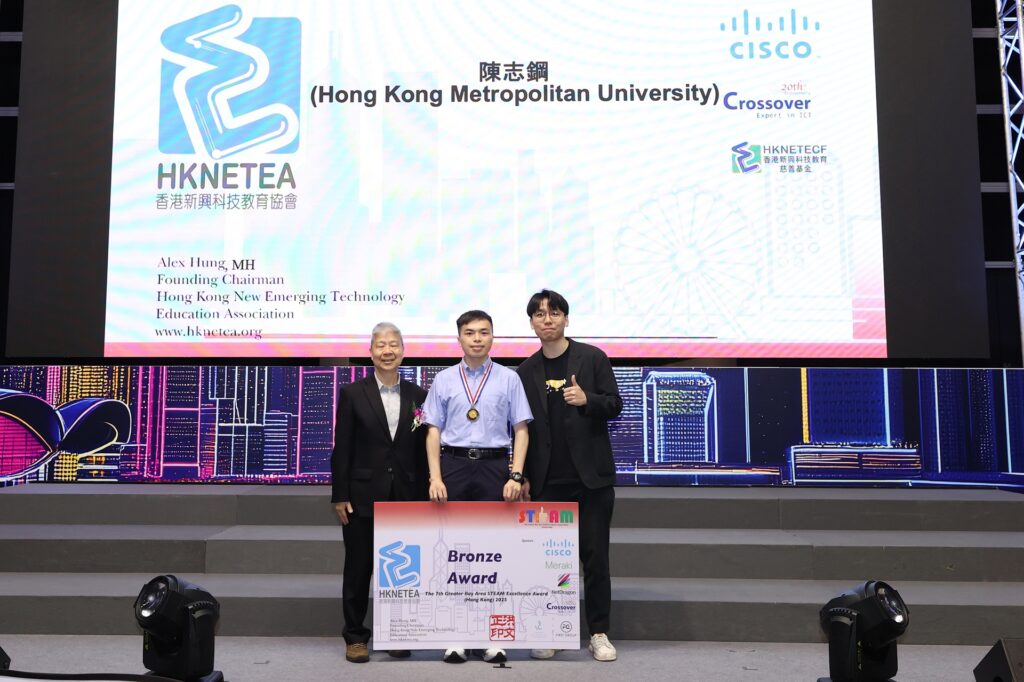
- Chan Chi Kong — Bachelor of Engineering with Honours in Electronic and Computer Engineering
Project: Air Drum Kit — Bronze Award (Information Technology Category)
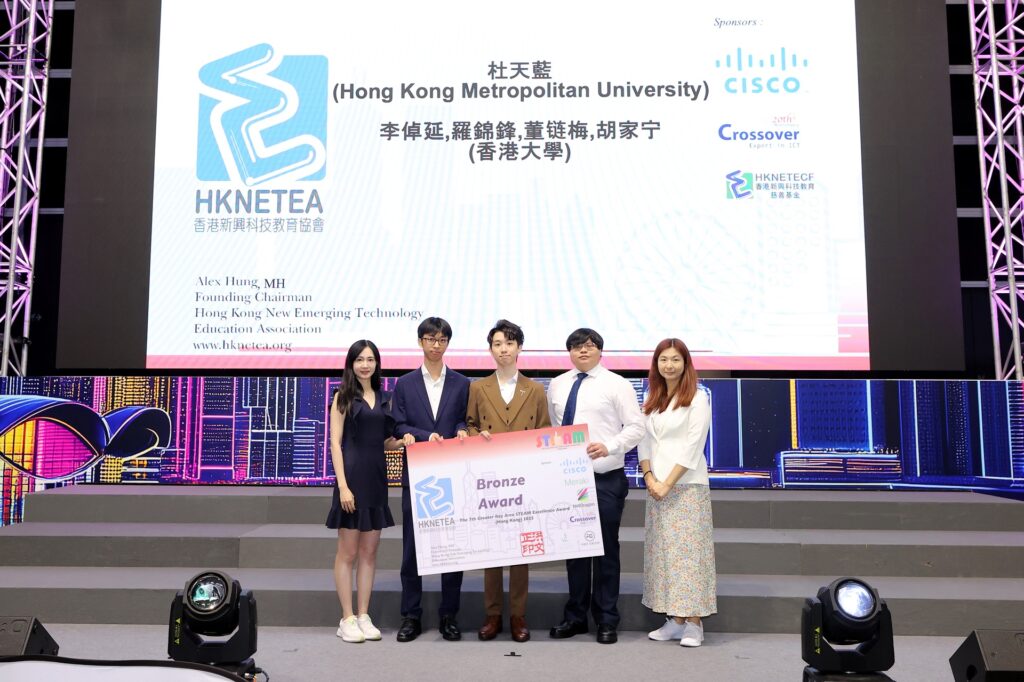
- To Tin-lam — Bachelor of Engineering with Honours in Electronic and Computer Engineering
Project: AI for Type 2 Diabetes Mellitus Detection — Bronze Award (AI Category)
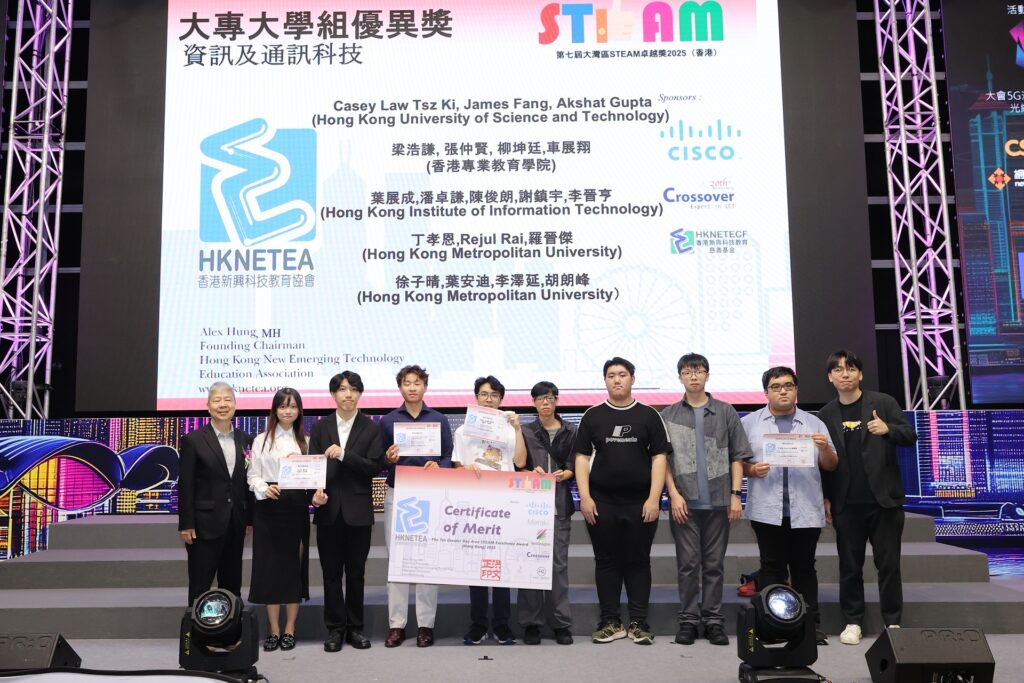
- Kenneth Charles Ting, Law Chun-kit and Rejul Rai — Bachelor of Science with Honours in Computer Science
Project: Legal chatbot for Minority Ethnic Groups — Merit Award (Information Technology Category)
- Chui Tsz Ching, Yip On Tik, Lee Chak Yin, Wu Long Fung Eugene — Bachelor of Science with Honours in Computer Science
Project: Smart Glasses for Hearing Impaired in Hong Kong — Merit Award (Information Technology Category)
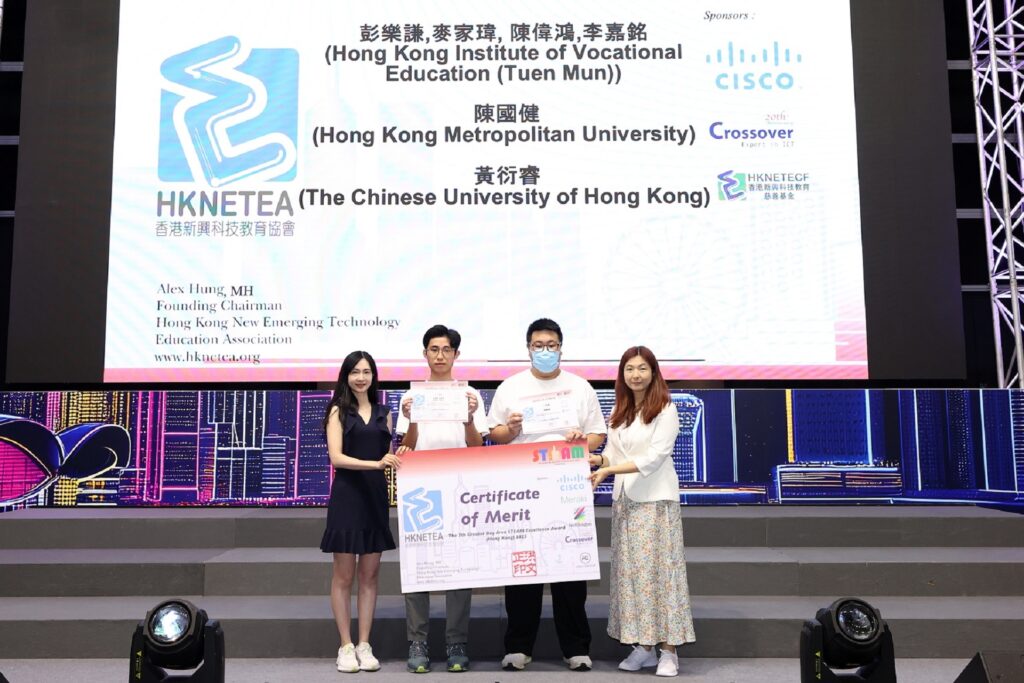
- Chan Kwok Kin — Bachelor of Science with Honours in Computer Engineering
Project: AI-Powered Mobile Robot for Guiding Rehabilitation Sessions — Merit Award (AI Category)
Chan Chi Kong won the Bronze Award for his project, “Air Drum Kit”, which proposed developing an air drum kit for convenient drum learning, practising, and busking when compared to conventional, physical drum kits. The prototype is a compact glove-based device equipped with a gyroscope, a microcontroller, and supporting circuitry. Using the device, the user can produce the sound of a snare drum, hi-hat, and crash cymbal just by mimicking the action of drum playing. No musical instruments are needed.
To Tin-lam won the Bronze Award for his project, “AI for Type 2 Diabetes Mellitus Detection”, which proposed developing a risk assessment platform for instant, reliable, scalable and adaptable detection of type 2 diabetes mellitus (T2DM). Extensive experiments were conducted to evaluate and compare the performance of T2DM detection using 25 artificial intelligence models. The project also addressed relevant cybersecurity issues, data protection protocols, the business model and its potential commercial value.
Kenneth Charles Ting, Law Chun-kit, and Rejul Rai were awarded the Merit Award for their project, “Legal chatbot for Minority Ethnic Groups”, which aims to assist ethnic minorities in Hong Kong by addressing language barriers and improving access to legal resources. Supported by industry partner ThinkThinkSyn Limited, the project designed a multilingual platform to provide accurate, Hong Kong-specific legal information through advanced technologies, including natural language processing, a cloud-based translation API and user-centric design principles. The system supports both text and voice input in English, Nepali and Urdu, ensuring accessibility and inclusivity for diverse communities.
Chui Tsz Ching, Yip On Tik, Lee Chak Yin, Wu Long Fung Eugene were awarded the Merit Award for their project, “Smart Glasses for Hearing Impaired in Hong Kong”. In this project, the team introduced an innovative solution, the Smart Subtitle Glasses (SSG), aimed at improving accessibility and communication for individuals with hearing impairments. Unlike conventional assistive technologies, SSG seamlessly integrates real-time speech-to-text transcription (STT) and multilingual translation capabilities within an augmented reality (AR) wearable device. The system is composed of two primary modules: a speech recognition module and a translation module. Both modules utilize state-of-the-art pre-trained models (PTMs) to deliver accurate and efficient real-time transcription and translation, ensuring exceptional performance with minimal latency.
Computer Engineering student Chan Kwok Kin also received the Merit Award for his project titled “AI-Powered Mobile Robot for Guiding Rehabilitation Sessions” which addresses the growing healthcare challenges in Hong Kong caused by an aging population and a shortage of medical staff. Collaborating with the Community Rehabilitation Service Support Centre (CRSSC) of the Hospital Authority, the student developed a navigation and feedback software module for a mobile robotic assistant designed to guide patients during rehabilitation exercises.
Organised by the Hong Kong Emerging Technology Education Association, the Award aims to enhance students’ creativity and innovation, and recognise schools, teachers and young talents for their efforts in STEM.
|