A Bridge Between Laboratory Science and Practical Application

Office of Research Affairs and Knowledge Transfer Impact Cases A Bridge Between Laboratory Science and Practical Application

A Bridge Between Laboratory Science and Practical Application

Key points

  • Biosensors have many uses, from disease diagnosis and biomedical research to environmental monitoring and forensics, but relying on laboratory-based biosensor tests can cause significant delays.
  • Low-cost, easy-to-use biosensors can bring this sophisticated technology into the field, and enable rapid detection and diagnosis.
  • Researchers at HKMU are working on biosensors to tackle real-world problems in health and environmental management.

Researcher

School

School of Science and Technology

The first step to addressing any problem is to know it is there. When that problem is microscopic, such as the presence of unwanted microbes in waste water, lactate in human sweat, or contaminants in pharmaceuticals, detecting that presence often requires sophisticated laboratory tests. As a biochemical engineer, Chen Jianlin, Associate Professor of Applied Science at Hong Kong Metropolitan University (HKMU), can run tests in a laboratory without difficulty. However, he knew it would be a lot more help if the tests could be taken out of the lab and right to the site of the problem. This could speed up diagnosis, and get vital, perhaps even lifesaving, information immediately into the hands of those who need it.

Chen's research focuses on biosensors, devices that measure biological or chemical reactions by generating signals proportional to the concentration of the substance under analysis. Having worked on environmental protection research projects in the highly controlled environment of a university laboratory, Chen could see that there was a real need to be able to run tests in the field, rather than having to send samples off to a laboratory and wait for the results.

One example is wastewater treatment. Anaerobic treatment is used to deal with heavily polluted water, via microbes which degrade organic matter in an oxygen-free environment, converting it into methane in the process. The balance of microbes is crucial, and the process is highly sensitive to adverse contaminants. Detecting their presence in influent, before they go into the water treatment system, is key to maintaining the right balance.

Typically, measuring this requires sending samples to a laboratory for testing. “It's a process that uses a lot of very expensive equipment and it takes at least two days,” explains Chen. “If you can measure at the site, immediately, the benefit is huge. Firstly it's time-saving, and secondly, once you have the information that a batch of influent is contaminated, you can, for example, change the tank parameters, and use some buffering techniques to contain the influent.”

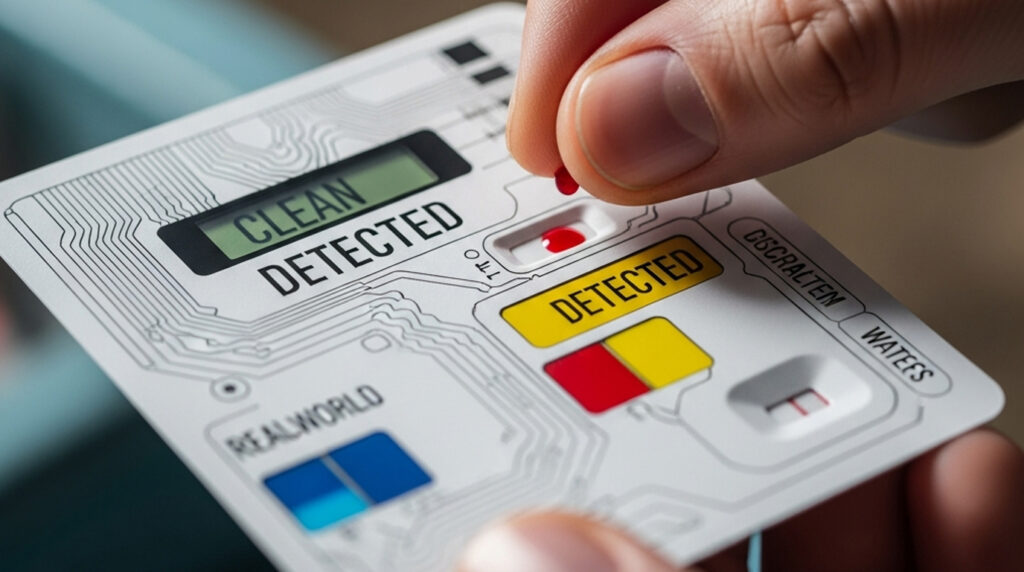
The technology behind this biosensor is highly sophisticated, but Chen wanted the process to be as simple as the high school chemistry class pH test, with a reagent strip. “So the design idea came from that; I wanted to know if I could use a paper strip, drop the liquid onto it, then get the result several minutes later, half an hour at most,” he explains. The test results come out in the form of colour changes similar to a pH test, and it uses a smartphone app to ensure an accurate read of the colour change information. “This cannot treat the problem, but it can tell people there’s a problem and can prove it unequivocally and quickly,” says Chen.

With a career starting out in environmental engineering, Chen's interest in finding practical applications for biosensors has also taken him into the medical field, including a simplified, portable and highly sensitive assay that can, within minutes, detect various bio-toxic agents, such as Enterococcus faecalis, a bacterium commonly found in the human gastrointestinal tract that can cause serious healthcare-associated infections.


Chen and colleagues have recently developed a self-powered wearable electrochemical sensor that can stick to the skin and detect lactate in human sweat. The technology behind the assay has also been patented. He got the idea from watching the thousands of marathon runners at a major marathon held in Hong Kong every year. “For marathon runners, it's very critical to have an indicator for whether or not they need to drink water,” he said. Serious runners often use expensive smartwatches to measure lactate and other signs of physical distress, but the technology designed by Chen and colleagues is an ultra-cheap sticker that simply changes colour. It is not only marathon runners that need to monitor dehydration levels. Frail older adults, for example, could be tested in a non-invasive, very low-cost way using this patch. It also has applicability in resource-constrained settings such as low-income countries, as a quick, reliable medical test.

“With this kind of a patch, the cost is very, very low, and it’s environmentally friendly, because it uses hydrogel as the conductive material,” says Chen. “We are also applying for the patent for similar technology that measures glucose in human sweat, another test that usually requires a blood sample,” he adds. The two tests could be combined in one sticker.

Other biosensor projects in the pipeline include an electro-biochemical sensor than can be used to analyze, for example, tiny quantities of pharmaceutical residues, or bacteria. Another project will take Chen's work from the molecular level to that of population health. “Human beings are creating more and more new chemicals, including ones that are toxic, and released into the environment,” explains Chen. “So I want to study, not just biosensors, but a bio-analytical method to detect such toxins, and then use that data to create a population-level database.”

Chen's career has taken him to a variety of settings, from Israel, to New Zealand to Singapore, before settling down in Hong Kong, so he has a number of comparators for working in the city, and has found Hong Kong to be a supportive environment for someone who wants to try out new ideas, and develop them into practical applications.

“In Hong Kong, there is support from the government to develop manufacturing for innovations such as biosensors, especially for environmental pollution,” he says. The academic ecosystem also allows people to get into fields that are very difficult to enter in other countries if you are not already at a very senior level, he adds. HKMU's status as a University of Applied Sciences also helps Chen to connect with potential industry partners for commercial development of the technologies he's creating.

Getting the technologies out of the lab into the hands of those who need them is what continues to motivate Chen in his work. “A traditional environmental chemist gets the sample from the field and takes it back to the laboratory to generate the data, but with what I'm doing, non-experts can use this kind of device and then get the information by themselves. I think that’s what we need: a bridge between the laboratory and the customer.”