With a gadget in development at Hong Kong Metropolitan University for frail older adults, being wheelchair-bound doesn't have to mean game over:
Key takeaways
- Tai-chi, even when practiced seated, has proven fall prevention benefits for older adults
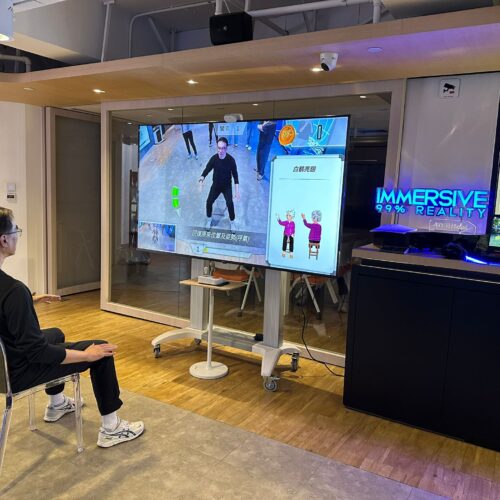
- Technology to track body movements can gamify seated tai chi, and collect valuable health data on participants
- Exergaming can help older adults independently maintain a seated tai chi practice
It's a common sight across Hong Kong, especially early in the morning. Under the shade of trees in of the city's urban parks, in public housing estate sitting out areas, on the boardwalk along the shimmering harbour, you can find tai chi practitioners, gracefully flowing from one stance to the next. Tai chi, developed in China in the mid 1600s, is based on Taoism, an ancient Chinese philosophy that emphasizes living in harmony with nature. Long considered by tai chi practitioners to have general health benefits, the martial art has also been the subject of extensive academic research, and has been found to improve balance control, cardiovascular health and muscle strength, and cognitive performance in older adults.
For wheelchair-bound older adults, the benefits of tai chi, practiced in these popular outdoor settings, can seem completely out of reach. In reality, a modified form of seated tai chi can still yield impressive gains. In the past decade, seated tai chi has garnered increasing interest as a way to improve older adults' hand-eye coordination and balance control, preventing falls and promoting active aging, explains physiotherapist William Tsang Wai-nam, Associate Dean (Development and Strategic Relationships) in the School of Nursing and Health Sciences at Hong Kong Metropolitan University.
Growing need for fall prevention
Tsang is particularly interested in what's known as the 'old old', those aged 75 and above. For them, in traditional tai chi, having to stand up, turn around and make steps is challenging because they are often frail and find it difficult to perform vigorous exercise. With seated tai chi, participants can focus on their upper limbs, and also the trunk. Once they've mastered this, for some there is scope for them to progress to standing tai chi, and on to the full, traditional form with its signature graceful turns and steps.
Tsang's interest in the potential benefits of seated tai chi was sparked by a trip to the hospital with his elderly mother, who had taken a fall and had to stay for observation. While he sat with her, Tsang realized that all around her were other older adults who had fallen down and were injured. “I thought if I could so something to help prevent falls, then the demand could be huge.”
Tsang was right about the demand: in 2024, 9.5% of Hong Kong's population was aged 75 and above, up from 5.2% 20 years earlier. Looking 20 years ahead, the trend is going to accelerate: by 2045, the 75 and over age group is projected to account for a staggering one fifth of the city's population.
Fall prevention is a complex area, that cuts across both physiological and neurological health disciplines, and this was why tai chi was so intriguing to Tsang. “Tai chi is a combination of the mind and body. As a physiotherapist I’m interested in how people move, their coordination and balance control, but I’m also interested in dual tasking, such as walking downstairs while performing a mental task. Tai chi can help with that dual tasking.”