



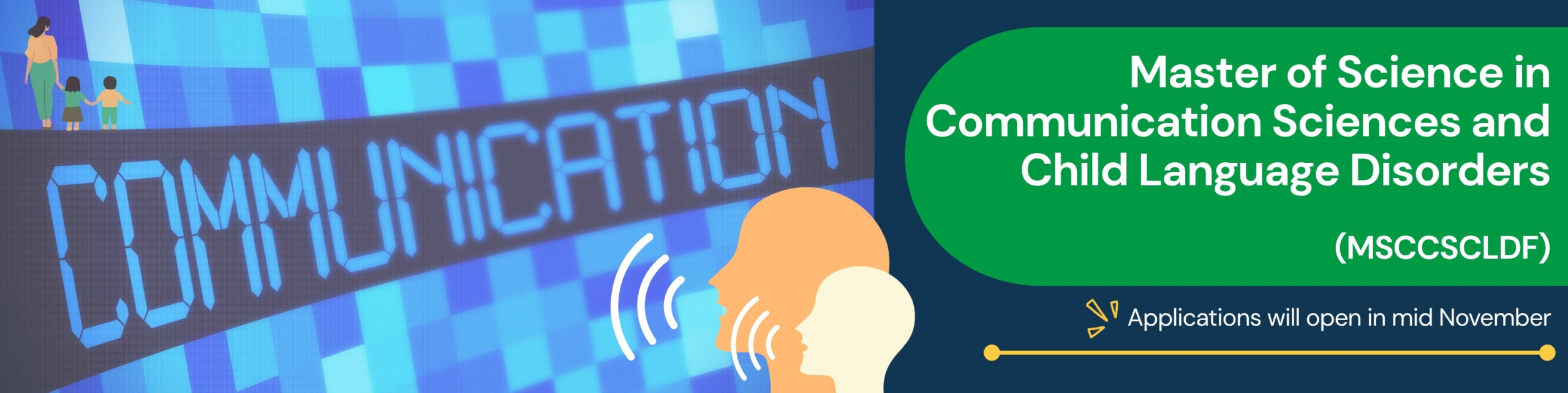




Master of Science in Communication Sciences and Child Language Disorders

School of Education and Languages Programmes & Courses Postgraduate (Full time / Part time) Master of Science in Communication Sciences and Child Language Disorders

Programme Code
MSCCSCLDF

Medium of Instruction
Putonghua

Study Duration
Full-time: 1 Year (3 Terms)
Part-time: 2 Years (5 Terms)

Study Mode
Face-to-face

No. of Credit-units
33

Tuition Fee
HK$181,500
(for 2026/27 intake)

Programme Introduction

Programme Introduction

This programme addresses national priorities in special and inclusive education, meeting the growing demand for language disorder assessment and intervention services in Chinese Mainland. It combines advanced theoretical knowledge with structured professional training, with a focus on the linguistic and cultural characteristics of Mandarin.

Leveraging the interdisciplinary strengths of the School of Education and Languages in linguistics, early childhood education, and special education, the curriculum covers key areas including child language development, communication disorders, assessment and intervention strategies, and inclusive education practices.

Through structured clinical practicums, students will develop core competencies in diagnosing, assessing, and supporting Mandarin-speaking children with special educational needs from preschool to primary levels. The programme aims to enhance Mandarin-speaking children’s language and communication abilities and contribute to the development of national language rehabilitation and inclusive education services in Chinese Mainland.

Programme Aims

Programme Aims

  • To equip students with comprehensive knowledge of the theoretical foundations and contemporary research in speech, hearing, language, communication sciences, and language disorders
  • To identify the speech-language-communication needs of Mandarin-speaking children with different types of special educational needs
  • To foster advanced skills for the assessment and intervention of communication disorders for Mandarin-speaking children
  • To promote professional attitudes and ethical standards required in related professional settings
  • To enhance the application of innovative approaches and technologies to facilitate assessment, intervention and language-related strategies
  • To develop students' abilities to apply and integrate research principles and methods into real practice
Master-of-Science-in-Communication-Science-and-Child-Language-Disorders-3.png

Programme Features

Programme Features

Field-based Clinical Training


Students gain real-world experience through supervised placements in diverse settings, where they apply evidence-based assessment and intervention strategies for children with language disorders.

Focus on Communication Disorders in
Mandarin-speaking Children

The programme exclusively focuses on communication disorders in Mandarin-speaking children, providing in-depth training on early intervention strategies for children aged 0 to 12.

Research Immersion


Students engage in faculty-led projects, utilising qualitative and quantitative analysis to address critical gaps in the field of communication disorders.

Programme Structure and Content

Programme Structure and Content

Students are required to complete 33 credit-units of courses, which comprises 24 credit-units of compulsory courses and 9 credit-units of elective courses, to fulfil the graduation requirements.

Compulsory Courses (Total 24 credit-units)

  • The Structure of Modern Chinese
  • Child Language Development
  • An Introduction to Communication Disorders
  • Assessment and Treatment of Speech Sound Disorders
  • Assessment and Intervention for Communication Disorders in Children
  • Specific Learning Disorder: Reading and Writing
  • Research Methods and Ethics in Communication Disorders
  • Field Placement

Elective Courses* (Total 9 credit-units)

  • Special and Inclusive Education
  • Counselling Skills for Communication Disorders
  • Supporting Children with Special Needs
  • Understanding Communication Issues in Autism Spectrum Disorder

*Not all courses are offered in each year

Entry Requirement

Entry Requirement

To be eligible for admission to the programme, a student should normally hold a recognised Bachelor's degree (or its equivalent) and must be proficient in both spoken and written Chinese (Mandarin).

Shortlisted applicants will be invited to an admission interview, and only those who pass the interview will be admitted to the programme.

Online Application: Please visit the Registry Taught Postgraduate Admissions and Enrolment website for details.

Medium of Instruction

Medium of Instruction

The medium of instruction for the programme is Chinese (Putonghua). Teaching materials are mainly in Chinese, with supplementary English readings.

Graduate Prospect

Graduate Prospect

Career Development

Graduates of this programme are uniquely equipped to take on impactful roles across diverse sectors, including:

  • Speech-Language Therapy
  • Inclusive Education for Students with Special Needs
  • Research in Communication Sciences
  • Non-Profit Organisation
  • Policy Advising in Child Development

Further Studies

This programme lays a strong foundation for advanced academic and professional development. Graduates may pursue:

  • Doctoral Studies (PhD) in
    • speech-language pathology
    • child development
    • linguistics
    • neuroscience, and
    • education
  • Clinical Certification in speech-language pathology

Frequently Asked Questions

Frequently Asked Questions

The Master of Science in Communication Sciences and Child Language Disorders centres on child language development and communication disorders, with a strong emphasis on assessment and intervention in Chinese-speaking contexts. This programme integrates the advanced theoretical knowledge with hands-on clinical training, specifically designed for the linguistic and cultural nuances of Chinese-speaking communities.

It is primarily practice-oriented, with strong theoretical foundations and clinical training components.

The medium of instruction for the programme is Chinese (Putonghua/Mandarin). Teaching materials are mainly in Chinese, with supplementary English readings.

The programme can be completed in 1 year full-time (in 3 terms) or 2 years part-time (in 5 terms).

Yes, a practicum is required in this programme and students will undertake supervised clinical practicums in relevant settings. The clinical practicum will take place in Chinese Mainland. Students must ensure their eligibility to stay in Chinese Mainland for the completion of the practicum. The associated costs (e.g. travelling or accommodation) will be borne by the students.

Tuition fees for the 2026/27 intake are HK$181,500. Please refer to the Registry website for updated fee information.

Yes, only shortlisted applicants may be invited for an interview to assess suitability.

Preference is given to applicants who meet one or more of the following criteria:

  • Hold a Bachelor's degree in linguistics, language studies, education, rehabilitation, speech and hearing sciences, psychology or healthcare;
  • Have relevant work experience with children with communication or learning difficulties;
  • Demonstrate English language proficiency through one of the following:
    • IELTS score of 6.0 or higher,
    • TOEFL score of 550 (paper-based) or 79 (Internet-based) or higher, or
    • CET-6 score of 430 or higher

Applications can be submitted online via the Registry (online admission portal). Ensure all required documents are uploaded before the deadline.

Enquiries

Enquiries

Programme Leader

Dr. GE Haoyan Emily

School of Education and Languages

mscscldf@hkmu.edu.hk

Registry – Admissions & Enrolment Team (Taught Postgraduate)

(852) 2768 6606
regae@hkmu.edu.hk
https://admissions.hkmu.edu.hk/tpg

Programme Flyer

Programme Flyer

Disclaimer: The contents of this website are subject to change or amendment without prior notice. The School of Education and Languages reserves the right to amend and provide interpretation as necessary.

Last update: Nov 2025