 |
From the President |

OLI students, graduates and staff welcome with excitement the Institute's recent change of status to the Open University of Hong Kong. The Upgrade had been the collective goal that our efforts have eventually borne fruit.
|
|
In order to better position the Institute for the political changes this year, and to tap the rich academic resources on the mainland, we visited Chengdu and Xian in 1996 to negotiate cooperative arrangements with some institutions there. In mid 1996 the Institute concluded an agreement with the Sichuan Union College of Vocational Education to offer the first Chinese Diploma in Business Administration in Chengdu. We hope to offer more OUHK courses in Xian and Guangzhou in the coming year to meet the rising needs for retraining and upgrading there. In the long run the OLI wishes to transfer the success of our open education system to the mainland.
To help the Institute's staff prepare for the transition, a series of seminars was held on the Basic Law, and on the latest developments in politics, economy, diplomacy and education in the mainland. An international seminar on 'Greater China' was organized and attended by academics from Hong Kong, mainland China and renowned overseas institutions. The year also saw the production of the first series of course-related television programmes in Chinese by the Institute.
On the technology front, the proposed Electronic Library is being turned into a reality with the successful solicitation of $40 million in grants and loans from the Hong Kong Jockey Club Charities Trust, the Croucher Foundation and the government. When the full system comes on line in summer 1998, the Library will have one of the largest electronic databases in the region.
A new campus-wide computer network was successfully installed to meet the scheduled relocation of the Institute from Mong Kok to its new home in Ho Man Tin. Consisting of a fibre optics-based backbone, this modern network is fast enough to support the latest technologies and educational applications. The network offers convenient access to global information superhighway as well as local computing and data resources directly from users' desktop PCs.
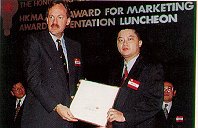
Mr Todd Ng Chun-ying (right), Senior Planning and Marketing Officer, receives the certificate of merit from the HKMA/TVB Award for Marketing Excellence. |
A pilot Internet project was launched in early 1997 for
1,000 students. The project was extended to cover about
4,000 students in April 1997.
The range of courses continued to expand during the year. A Master of Educaton, a Bachelor of Arts in Language and Translation, three science- cum-management bachelor degrees and three new Higher Diplomas in Science were introduced with satisfactory enrolment. As a result of the excellent performance by the Institute in marketing its MBA |
To answer the pressing demand for improved language standards, the OLI will develop quality language courses in both English and Chinese, and introduce optional language competency tests for its students in the near future.
During the year, 16 more companies joined the Employer Support Scholarship Scheme which promotes corporate sponsorship for employees to study at the OLI, increasing the total number of participants to 26. Twenty-eight corporations and philanthropists became the Institute's new Partners-in- Learning, and other long-lasting friends of the Institute either maintained or increased their level of assistance with new pledges. Partly in response to our call last year, the government increased its tax allowance to OLI students by nearly 70 per cent. All this indicates that the Institute is in good standing with and winning more support from the community.
Student support services were enhanced with the expansion of the Disabled Students Centre. Liaising closely with the Students' Union, the Student Affairs Office acts as an effective channel of communication between the management of the Institute and students. The linkage between the Institute and its graduates was also strengthened with the establishment of the Alumni Association.
In preparation for the move towards university status, additional staffing support was secured to step up academic and research development. The posts of Vice President (Academic) and Director of the Centre for Research in Distance Learning and Adult Education were created.
The Performance Related Pay Scheme was accepted by the management for implementation in mid-1977 to provide extra incentives for better performance and higher output. To ensure compliance with the newly enacted Personal Data (Privacy) Ordinance, the Institute set up a working group and appointed a Data Protection Officer.
With the award of self-accrediting status by the government, the Institute continued to perfect its internal quality assurance systems and procedures especially with the future role of a university in mind.
The Institute broke new ground in a number of areas in the last academic year. Indeed the OUHK is still a young institution where many exciting developments are taking place every day. We made history when we became the first local institution to attain university status in less than eight years - more quickly than any other local tertiary institution in Hong Kong. Our next goal is to become a leading institution in distance learning and adult education which will eventually be designated as a Centre of Excellence in the region. With our young spirit, drive and enthusiasm, we believe that more history will be in the making at the University in the near future.
|
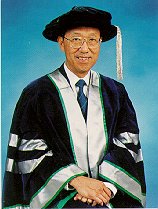
Professor Tam Sheung-wai President July 1997 |

|
 |
 |
 |
[HOME] [University Profile ] [Mission Statements ] [Contents ]
Copyright 1997 The Open University of Hong Kong
For comments and suggestions, please contact webmaster@ouhk.edu.hk
For enquiry on admission, study and courses, please contact regwww@ouhk.edu.hk