|
Universities are places where knowledge is created as well as acquired. Experience worldwide has shown that involvement in research enhances the quality of both teachers and students. The OUHK therefore encourages academic staff to participate in research and provides grants for a number of such projects every year. We also encourage our academics to share their experience and stay abreast of the latest advances in knowledge by attending regional and international scholarly events.
Funding worthwhile research
Our academics can apply to the President’s Advisory Committee on Research and Development for grants from the OUHK Research and Development Fund. During the year, an average of $348,000 was disbursed for each approved project.
In addition, each of our academic units is allocated its own annual research fund. Staff members may apply for a small grant or seed money for their projects from this fund, with a $30,000 ceiling for each project. Individual academic units can also seek additional grants to fund research and development projects, if necessary.

Our academic staff may also approach external bodies for funding. For example, funding applications for proposed projects – especially those aligned with the University’s mission – may be submitted to the Education Bureau for consideration by the relevant committees of the Research Grants Council.
For all on-going research projects, regular reports to their funding authority are required; and final reports have to be submitted when the studies are completed. Noted below are some examples of projects completed during the past year.
Better training for neural networks
An artificial neural network requires a learning algorithm that allows computer systems to recognize patterns according to examples. There are a number of ways to train an artificial neural network, but these often suffer from a phenomenon known as ‘local minimum problem’, which makes the training stall.
During the project, Dr Vanessa Ng and Dr Andrew Lui from the School of Science and Technology and Dr Cheung Chi-chung from the Hong Kong Polytechnic University studied the strengths and weaknesses of existing learning methods. They found that each of them demonstrated different training characteristics during different phases of the process. It was also discovered that the local minimum problem could be avoided if a suitable learning method was applied during each phase.
Two learning algorithms the researchers developed during the project may represent a breakthrough in learning algorithms for neural networks, as they improve the training performance greatly in terms of local minimum avoidance and global convergence capability.
The tide turns on red tides
Harmful algal blooms (HABs) or red tides are a significant global problem. Some of the HAB causative agents produce neurotoxins that can make people sick or even die if they are ingested. For example, paralytic shellfish poisoning is a serious fatal disorder caused by ingesting shellfish that contain a high level of neurotoxin. The genus Alexandrium is one of the most serious and common neurotoxin producers and HABs caused by Alexandrium have become more frequently and geographically widespread during recent decades.
In their study, the Dean of the School of Science and Technology, Prof. Ho Kin-chung, and Dr Fred Lee from the School explored the phylogentic relationship between the Alexandrium tamarense strain found in the Southern Antarctic Ocean and other strains. The findings showed clearly that the Antarctic strain is closely related to the Asian ribotypes, especially species from the China Sea. This provides important insights into the origin and global distribution of Alexandrium tamarense and the dispersal mechanism of toxic marine algae around the world.


Understanding molecular structures
Structural study is one of the most exciting chemical research areas at present, since it can glean more information about exact molecular structures than any other method. During this project, a team of researchers from our School of Science and Technology, the Chinese University of Hong Kong and Sun Yat Sen University successfully synthesized four crystalline compounds with guest molecules and characterized them by X-ray crystallography.
They discovered that the hybrid supramolecular network is constructed from 4,4’,4”-[1,3,5-benzenetriyltris (carbonylimino)] trisbenzoic acid, and that substituted isocyanuric acid and derivatives, which are easily obtained by two-step synthesis, can also be complexed with guanidium and biguanide bases.
Scholarly activities
ACU Conference of Executive Heads
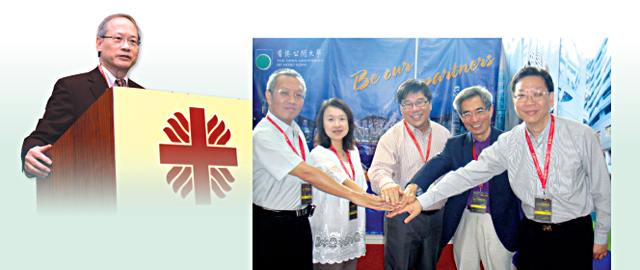
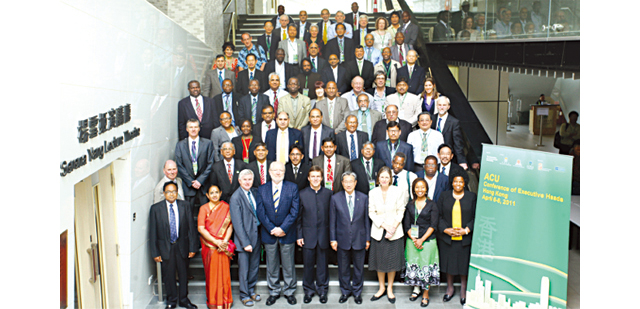
The OUHK co-hosted the three-day Association of Commonwealth Universities (ACU) Conference of Executive Heads 2011 together with the ACU’s two other local members, the University of Hong Kong and the Chinese University of Hong Kong.
The theme of the three-day conference in April 2011 was ‘Higher Education in Hard Times – Risk, Reputation, Reform: Developing New Business in a Changing Environment’. It was attended by more than 150 vice-chancellors and representatives from 127 universities and institutions in 22 countries and regions. The OUHK hosted the final day of the conference which focused on the commercialization of research and innovation in modern universities.
Open education forums
The OUHK is an active member of both the Asian Association of Open Universities (AAOU) and the International Council for Open and Distance Education (ICDE).
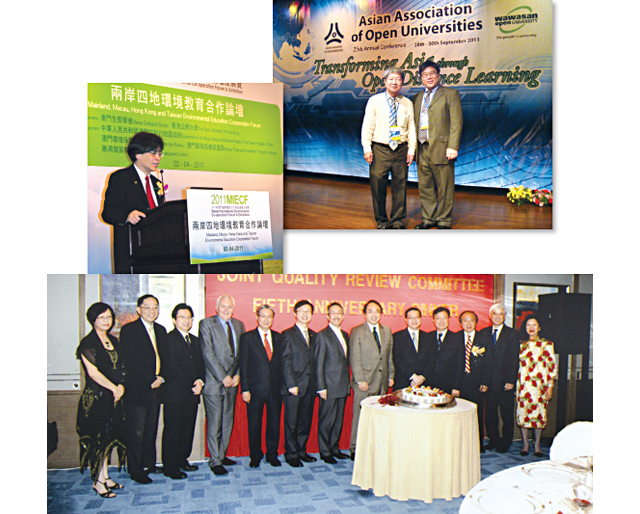
Dr Li Kam-cheong, the Acting Director of our Centre for Research in Distance and Adult Learning (CRIDAL), and Dr Jack Shu Chi-yee, Assistant Professor in the School of Education and Languages, participated in the 25th AAOU Annual Conference, which was held in Malaysia in September 2011. They each presented a paper on innovative applications of blended learning.
Prof. Danny Wong, Vice President (Academic), led a delegation to the 24th ICDE World Conference in Indonesia in October 2011. Prof. Wong and Dr Li Kam-cheong, presented papers at the conference.
Learning on the move
In July 2011, the annual International Conference on ICT in Teaching and Learning on the theme ‘Education Unplugged: Mobile Technologies and Web 2.0’ was co-organized by the OUHK, the Hong Kong Web Symposium Consortium, Caritas Institute of Higher Education and a number of other institutions in Hong Kong. More than 150 local and overseas academics discussed how mobile learning technologies support and enhance the learning process in their work. Prof. Leung Chun-ming, Vice President (Technology and Development), was one of the keynote speakers and delivered a speech on ‘The Future of Learning in a Mobile and Connected World’ on the first day of the conference.
Sharing insights on self-financed education
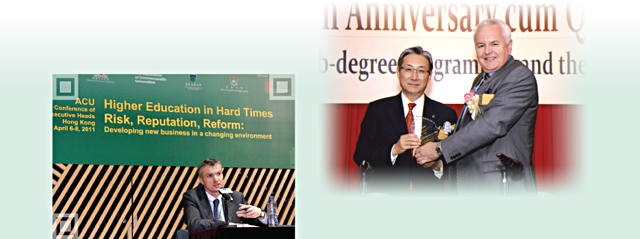
Prof. John C Y Leong, our President, was among the speakers at the 5th Anniversary Symposium organized by the Joint Quality Review Committee in June 2011. Prof. Leong gave a presentation during the discussion session on ‘What is Expected from Sub-degree Graduates: Perspectives from Schools, Higher Education Institutions and Employers’. The symposium also had keynote speakers from overseas and was attended by more than 200 participants from 55 educational institutions and organizations.
Co-operation in environmental education
The Dean of the School of Science and Technology, Prof. Ho Kin-chung, hosted the ‘Mainland, Macau, Hong Kong and Taiwan Environmental Education Cooperation Forum’, which was co-organized by the School and the Macau Ecological Society and held in Macau during April 2011. The event was a valuable opportunity for about 100 participants to exchange information and enhance collaboration.
In August 2011, a seminar in Macau which explored the development of environmental protection technologies was staged jointly by the School and the Macau Business Management Educational Centre.
|