







MU Connect issue 10 (page 12 to 13)

Home About HKMU University Publications MU Connect MU Connect issue 10 (page 12 to 13)

180-degree change: Interview with the first inmate doctor in Hong Kong

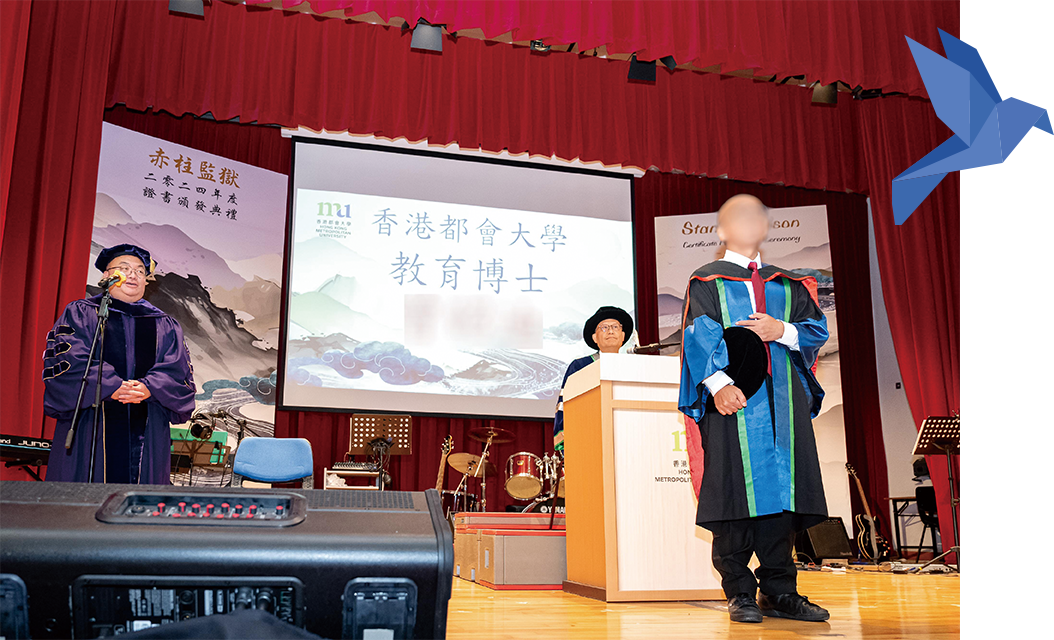
While it has transformed into a comprehensive university with a full-time student population ranking fifth among local universities, HKMU continues to uphold its “Education for All” mission by offering people from various backgrounds the opportunity to receive a university education through different learning modes. It is also the only university in Hong Kong that offers degree programmes for people in custody via distance learning, and has been contributing to inmate education since 1990. Earlier this year, the University conferred a historic doctoral degree — the recipient was Chun (pseudonym), the first person in Hong Kong to earn a doctoral degree under custody. After eight years of hard work behind bars, he fulfilled all requirements to be awarded a Doctor of Education.

Chun's doctoral thesis looks into prison inmates' conceptions of “imprisonment” and “learning under custody”. After getting into prison, he completed the Hong Kong Certificate of Education Examination (HKCEE) in 2000. He then went on to pursue a Bachelor of Social Sciences degree majoring in psychology in the then OUHK via distance learning in 2004, obtained a Master of Education in 2012, and got admitted to the Doctor of Education programme in 2016.

As a veteran among his fellow inmate students, Chun often lends them a helping hand with their studies. This experience sparked his interest in his research topic. His study found that inmates who have a superior conception of “imprisonment” also have a superior conception of “learning under custody”. “The highest conception of imprisonment is the reforming of one's attitude of life, whereas that of learning under custody is personal transformation. In the eyes of inmates with these superior conceptions, imprisonment is no longer a punishment, and learning under custody is no longer purely learning, but an opportunity for them to become better selves,” he explicates. 

After years of exploration, Chun has definitely developed a superior understanding of both concepts. When he landed in jail, he was utterly disoriented, and he looked to studying as a means to find answers to his life questions. He first took up business administration, but realised it could not serve his purpose. He then made a switch to psychology, which helped him make sense of his needs via the lens of knowledge such as Maslow's needs theory. “I understood that the self as I perceived it was very different from that in reality. Say, I thought I was not a bad person, but in objective reality, I could not be considered a good person. By understanding myself, coupled with my religious faith, I slowly rebuilt my morals and values. There was also the influence of rehabilitation activities by the Correctional Services Department (CSD),” he says.

Chun states in the personal remark of his doctoral thesis, “If I can, so can you.” He writes in reflection of his life, “My past was a failure. Dropping out of school early, I could only do low-skilled work. For more than two decades, I was dillydallying, until I committed this terrible crime and landed in jail. I felt like falling into a bottomless abyss in all aspects of life. I would say my life was completely over. However, refusing to give up, I kept going. Despite not being able to see what was ahead, I kept moving on and on. And today, I've got a doctoral degree; I'm gradually finding my way and my hope! Eventually I've come to understand that my logic was reversed: I shouldn't have held off departure until hope was in sight; hope only comes into sight as I set off.” He encourages young people who are at a loss: “Giving up brings failure. Perseverance breeds success.” 

Studying in prison is challenging, not least because of the lack of Internet access. During all this time, Chun had to rely on his HKMU supervisor to bring him reference literature. “I would let him know my focuses and he would bring me huge quantities of materials to look up which was useful. This means I had to read several times more materials than other students do.” Chun is especially grateful to his supervisor, who visited him in prison at one- to two-month intervals, for expressing personal concern for his life and his future. “These were beyond his responsibilities, but he was willing to give me more support than he was obligated to.”

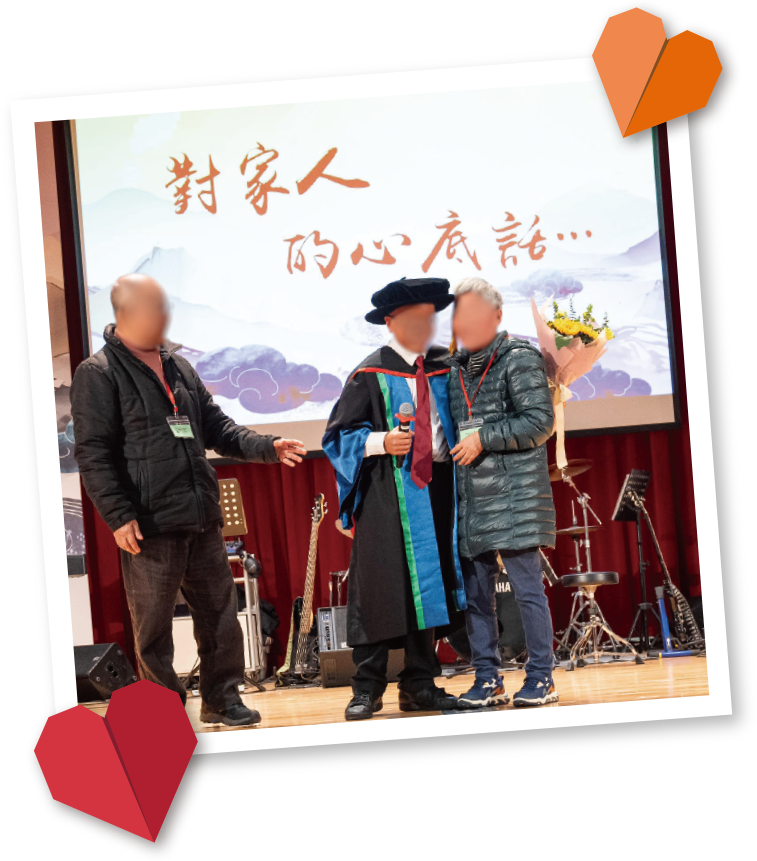
While Chun is very thankful to the University, his supervisor and tutors, CSD staff, chaplains and volunteers for their support over the years, his greatest source of motivation has come from his family members. “I'm extremely indebted to my parents, brother and sister-in-law. When my doctoral application was rejected for several years straight, they encouraged me not to give up, not to despair, and just hang in there; when I needed some textbooks, they found and purchased them for me without saying a word. They have never given up on me even though I committed a crime and ended up in jail. This is what 'family' is about.”

Chun pens words of appreciation for those who have supported him:
Full script of the written interview

Q:

We are the Public Affairs Office of Hong Kong Metropolitan University. On behalf of the University, we would like to congratulate you on obtaining a doctoral degree. It has been a while since you achieved this milestone. How are you feeling now?

A:

I'm certainly happy about getting a doctoral degree. This experience also brought me a sense of achievement and satisfaction, and made me understand that in many cases, limits do not really exist; it is we who imagine those limits. It is thinkable to make the impossible possible as long as we are willing to try.

Q:

Your doctoral thesis looks into the conceptions and learning motivations of people in custody. What have you discovered? How did your interviews with other prison inmates inspire you?

A:

My study identified two conceptions, namely the conceptions of “imprisonment” and “learning under custody”, and it found that the two conceptions are interrelated. In other words, if inmates have an inferior conception of “imprisonment”, they will also have an inferior conception of “learning under custody”; conversely, if inmates have a superior conception of “imprisonment”, they will also have a superior conception of “learning under custody”. Interestingly, there are many similarities between the superior conceptions of the two areas. The highest conception of “imprisonment” is the reforming of one's attitude of life, whereas that of “learning under custody” is personal transformation. What is common between the two is the transformation of the self into a better person in order to live a better life. In the eyes of inmates with these conceptions, imprisonment is no longer a punishment, and learning under custody is no longer purely learning, but an opportunity for them to become better selves; or in Christian terms, sufferings are no longer curses, but blessings. During the interviews, I found that inmates with such conceptions were more positive than the others. From the study, I also discovered a developing tendency in these conceptions. That is to say, they can be cultivated to develop from an inferior level to a superior level. If this hypothesis is proven, I believe it will benefit groups working on rehabilitation, as it shows that first, no people or things are unchangeable, and second, rehabilitation goals are attainable. Rehabilitation goals are, perhaps, the reforming of one's attitude of life and personal transformation.

Q:

What difficulties did you encounter in the process of writing the thesis? How often did you meet or correspond with your supervisor? What kind of support or guidance did he provide you with?

A:

The most difficult part of writing the thesis was to look for references as I didn't have access to the Internet in prison. I would let my thesis supervisor know my focuses and he would bring me huge quantities of materials to look up which was useful. This means I had to read several times more materials than other students do to locate useful materials. My thesis supervisor was very nice. He visited me in prison every one or two months to give me guidance. Without him, I would have detoured a lot. Thank you, Dr Thomas Tang.

Q:

Were there any memorable moments in your interactions with your supervisor?

A:

I think my most unforgettable memory with my supervisor was that every time we met, he would give me new inspiration. Sometimes I would feel stuck in unresolvable problems for weeks, and he could help me find clarity with just a few words. And today I still find it unforgettable that every time he came, he would ask me about my life and my future. These were beyond his responsibilities, but he was willing to give me more support than he was obligated to. This is perhaps an even greater gain for me than earning knowledge.

Q:

You were the first person to receive a local doctoral degree under custody. How did you find the courage to embark on this journey in the first place? Was there anyone who encouraged or inspired you to pursue this goal?

A:

In prison, in addition to my own studies, I would help my fellow inmate students study and cope with exams. In the process, I discovered many interesting phenomena. For example, some inmates only aim to pass and therefore just learn by rote, while others are able to apply their knowledge in other contexts, even in their daily lives. I was curious about this difference, which underpinned my future research direction.

I'm thankful to many people who have encouraged me to continue my study journey and pursue my doctoral dream. Among them were CSD staff, chaplains and volunteers. Surely, I also believe in God's plan and guidance. I must also thank my family members — they were my motivation for perseverance too! Even though I failed my doctoral application numerous times, my family members always encouraged me to keep trying, and I did try year after year, until being admitted eventually. Thank you to everyone who has encouraged me.

Q:

Compared to the previous learning stages, how would you describe your study experience in the past eight years?

A:

It takes a lot of discipline to study in prison, as no one will coerce you to study. And I had to be even more disciplined than before when pursuing the doctorate in the past eight years. I must set a schedule for my targets and keep up with it, or I would risk missing the deadline for graduation. Discipline was all the more important.

And pursuing a doctorate was different from my previous studies in that, in the past, I learnt knowledge by drawing on the wisdom of our predecessors, but in studying for a doctorate, I contributed to the creation of knowledge by supplementing or dismissing information. This extends the thinking process to incorporate, for instance, critical thinking. Learning without critical thinking will result in no more than derivative work.

Q:

Looking back, when did you start reflecting on questions like “What is life” and “What wrong have I done”?  What changed your perception towards studying, so that you started viewing it as a means to finding your direction in life?

A:

When I first landed in jail, I was tormented by many questions about life: Why would I end up in jail? As I calmed down, I attempted to find these answers through multiple channels, including religion and philosophy books. Studying was one of these channels.

In 2000 I picked up my studies again and sat for the HKCEE, securing a C in Accounting, followed by pretty good results in an LCCI exam. Therefore, when I enrolled in university, I made the obvious choice of taking business administration. The first course I took was principles of management, but later on I realised it couldn't really help me find the answers I was looking for, so I made the decision to switch to psychology courses, which helped me make sense of myself in the process of studying.

Q:

You have earned several degrees by now. How has studying helped you rebuild your values and made you a better person?

A:

I think it was the period of studying psychology that marked my greatest change. In the process, I understood my shortcomings, such as my egocentricity. I also figured out what I actually needed. For example, Maslow's hierarchy of needs allowed me to see that many a time, the self as I perceived it was very different from that in reality. Say, I thought I was not a bad person, but in objective reality, I could not be considered a good person. By understanding myself, coupled with my religious faith, I slowly rebuilt my morals and values. There was also the influence of rehabilitation activities by the CSD. For instance, participating in shows and sharing under the Rehabilitation Pioneer Project made me understand the damage of drugs and experience the joy of contributing to society, while joining a band show helped me recognise the importance of collaboration and improve my interpersonal skills. I was able to rebuild morals and values thanks to knowledge learnt from school and activities by the CSD.

Q:

We heard that you are studying English Language Studies. What are your present study goals?

A:

After getting the doctorate, I went on to study another subject for the associated qualifications. I've already applied to the University for graduation from the Bachelor of Language Studies (English), and I'm expected to graduate this year if all goes well. The past two years have been really fruitful; I'm reaping the fruits of my continuous efforts. In the future, I'll continue to study subjects I'm interested in. When I'm released, I wish to enter a seminary, tentatively to study Christian counselling. During my long study journey, I've developed the habit of studying and learning; I've also come to understand that the more I learn, the more I realise how little I know. Facing the ocean of knowledge, I must humbly admit my deficiency in order to improve. I'll continue to study in keeping with the goal of lifelong learning. I hope this can encourage more people to get onto the same journey.

Q:

What do your fellow inmates think about your studies? Has your learning attitude affected them? Have you had any opportunities to share with them your transformation?

A:

My fellow inmates respond variously to my continuous studies. Some are scornful, while some are happy for me; some are supportive, while some have mocked me. But I'm glad that most responses have been positive. Thanks to the support and encouragement of my family, CSD staff and volunteers from church, I've been able to face up to these responses most of the time.

I dare not say my learning attitude has been a great influence on other inmates, but I've always supported and encouraged them not to waste time and to enhance themselves by studying. Gradually, some of them have joined our family of learners. I've noticed improvements in the learning ambience with more inmates enrolled in HKMU every year. This has been a positive change.

Q:

You expressed in an interview that you had to overcome many difficulties to study in prison, and on several occasions, you were on the verge of giving up had it not been for the support of your family. Over the years, have they said or done anything that you were particularly impressed with?

A:

I'm extremely indebted to my parents, brother and sister-in-law — my dear family members — for not giving up on me all these years, and for supporting and encouraging me. They may be reticent and not necessarily good at expressing themselves, but their actions say it all. For example, when my doctoral application was rejected for several years straight, they encouraged me not to give up, not to despair, and just hang in there; when I needed some textbooks, they found and purchased them for me without saying a word. Even if they weren't available, they would ask friends and colleagues to help me. Instead of clanging cymbals, they have always told me with real actions how much they support and care for me. They have never given up on me even though I committed a crime and ended up in jail. This is what “family” is about. Although they haven't made any grand statements, I owe a huge debt to them for what they have done for me.

Q:

You wrote in the personal remark of your doctoral thesis, “If I can, so can you.” Could you please share your wisdom with young people who are at a loss in life or in their studies?

A:

There's no need to look down on yourself at all. My past was a failure. Dropping out of school early, I could only do low-skilled work. I had no achievement whatsoever and could only linger at the bottom of society. For more than two decades, I was dillydallying, until I committed this terrible crime and landed in jail. I felt like falling into a bottomless abyss in all aspects of life. I had no idea when I would be released, and even if I were released, it would be two or three decades later. I would say my life was completely over. Could I see any future? Could I see any hope? Did I even have a life? When I first landed in jail, a senior inmate said we were a group of living dead, walking corpses that existed in a giant tomb — fair enough, that was a very close, even if not totally accurate description of reality!

Lost, puzzled, having no future, no hope, no life — none of this could adequately portray the pit I was in. 

But then, life was not yet over. I then realised, it was not that I had no hope or future; it was simply I couldn't see my hope and future.

Refusing to give up, I kept going. Despite not being able to see what was ahead, I kept moving on and on. And today, I've got a doctoral degree; I'm gradually finding my way and my hope!

Eventually I've come to understand that my logic was reversed: I shouldn't have held off departure until hope was in sight; hope only comes into sight as I set off. Had I not set off the other day, I could still be dillydallying today. I wouldn't have seen hope; nor would I have achieved what I have. I'm now harvesting all these gains only because I plucked up the courage to set off in the first place.

Friends, perhaps some of you are feeling lost, puzzled, lifeless and hopeless like I did. Trust me, I totally understand — I've been through the exact same journey. Don't be afraid! As long as life is not yet coming to an end, no one knows what will happen next. As long as you persevere, you'll see hope at some point. Set off and you'll see hope, not the other way round. I'd like to share my motto with you: Giving up brings failure. Perseverance breeds success.

If I can, so can you!

Q:

Finally, please handwrite a note to people you are most thankful to for our publication in the newsletter.

A:

Postscript:

Big thanks to HKMU for providing me with so many learning opportunities over the years. I have come across tutors of many different courses, and they have not looked down on me because I am under custody. Many of them have been willing to offer me appropriate help, and have been supporting me until witnessing my doctoral graduation.

I am also indebted to the current and former Deans of the School of Education and Languages for supporting and encouraging me to apply for the doctoral programme. Although I failed several times, they eventually admitted me and offered me scholarships to pursue my doctoral dream. I would like to express my heartfelt gratitude to them.

I must also thank HKMU for offering me a scholarship this particular year. This is recognition for my ongoing efforts. Please accept my sincere thank you.