







MU Connect issue 10 (page 10 to 11)

Home About HKMU University Publications MU Connect MU Connect issue 10 (page 10 to 11)

The adventure of a PhD student
in microplastics research

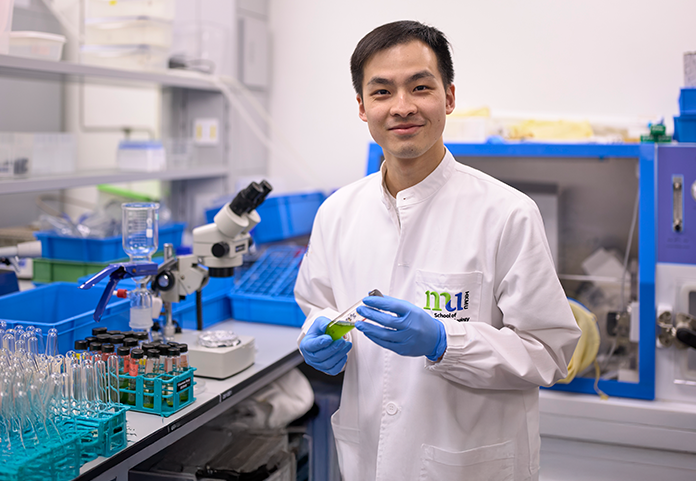
Microplastics are no doubt a cause for global concern. But gauging how bad the problem is is not as simple as it seems, as some of those particles are to small to be measured by traditional instruments. Aubrey Tse Yuet-tung, PhD student from the School of Science and Technology, has taken the challenge to break this bottleneck. His dedication to scientific innovation has earned him a “For Our Future Innovation and Technology Scholarship”, newly launched by the Greater Bay Area Homeland Youth Community Foundation to support excellent local PhD students studying STEM-related subjects.

Stepping into the world of scientific research

Interested in science and laboratory work, Aubrey began his undergraduate studies in testing and certification at HKMU. While he was fascinated by Discovery Channel, he knew very little about research. In the second semester of Year 3, he successfully applied for the position of part-time research assistant at the School, gaining his first taste of research under the supervision of his current supervisor, Dr Sidney Chan Man-ngai. Dr Chan, who also supervised Aubrey's final-year project, asked him to consider pursuing an MPhil after graduation. Being unsure what to do yet, Aubrey took the advice and embarked on his research journey in environmental science. Halfway through, he made up his mind to go for a PhD.

Aubrey discusses his doctoral project on microplastics risk assessment monitoring with great enthusiasm. “Microplastics research has been around for 20-plus years, but in fact what we call microplastics can span a wide size range from 1 micrometre to 5 millimetres,” he explains. “Due to technical limitations, most prior research went only as far down as 100 micrometres. Dr Chan therefore proposed measuring smaller microplastics with a flow cytometer, which is usually used in blood tests, as red blood cells are around several micrometres in diameter, similar to our target objects.” After repeated experiments, Aubrey managed to measure the extent of microplastics pollution in bottled water and sea water across the full range of 1 micrometre to 5 millimetres combining this technology with traditional methods; this was followed by an ecological risk assessment, proving that at least 5% of aquatic creatures are affected by smaller microplastics. In the meantime, he is focusing on the specific impact of microplastics on microalgae at the base of the marine food chain.   

By now, Aubrey has been a full-time researcher for five years, during which he published four journal articles and presented more than ten findings at different academic conferences. He still has vivid memories of first seeing microplastics with his own eyes. “I didn't believe microplastics existed in bottled water until my supervisor asked me to test the microplastics content in a sample. After injecting a fluorescent dye into the water and exciting it with laser, I saw many particles appear!”

Between the outdoors and the lab

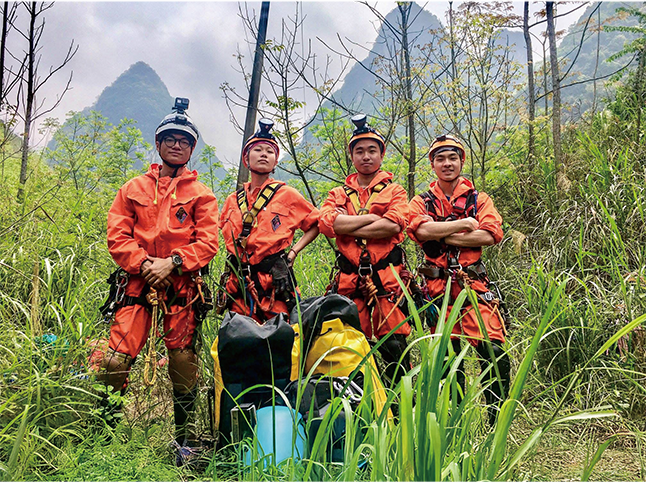
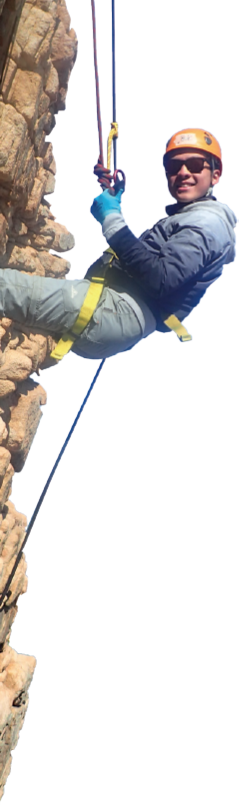
Aubrey is the opposite of the nerdy lab geek stereotype. Outside the laboratory, he is active in outdoor activities such as dinghy, high ropes, recreational abseiling and adventure training. He grew up participating in activities organised by Youth Outreach, where a member of his family works, and became a scout during secondary school. “Thanks to outdoor activities, I've come to appreciate the beauty of nature. But on the other hand, I saw how bad pollution was. There was always rubbish drifting on the sea. This urged me to think about doing something for the environment through research.”

Outdoor adventures have also helped Aubrey build resilience. “Those are all challenging activities. As in doing research, I don't always succeed,” he says. He goes on to describe a research bottleneck at the early stage of his doctoral project. “As plastics float on water, they aren't evenly distributed like blood cells. It wasn't as easy as imagined to measure microplastics with flow cytometry. I had no success for half a year despite making numerous adjustments.” The breakthrough came when one day he saw on television a programme that discussed how water striders utilise surface tension to move on water. Feeling inspired, he looked up the theory, fetched some dishwashing detergent — which reduces the surface tension of water — from the kitchen and broke up a plastic cap for a quick experiment. He found the clue.

Growing and helping others grow

Experiencing the benefits of adventure training, Aubrey started volunteering with Youth Outreach in Year 4. As an adventure coach, he helps young people build self-confidence and overcome adversities through adventure training camps. “The main target group of Youth Outreach is at-risk youth. Most of the students coming to our training camps are rather passive as they are obliged by their schools to take part. I encourage them to just have fun.” His greatest satisfaction is to see some inconspicuous students getting more and more motivated, eventually stepping up to become volunteers like him.

Although the camps usually only span three days and two nights, Aubrey grabs every opportunity to share his life experience with the participants. “I found myself grown up a lot in the past few years. I always tell the students, although my DSE scores fell short, I'm doing a PhD now.” Since doing research, he has also learnt that academic performance is not necessarily linked with work ability. “I had pretty good grades in my undergraduate courses, but while conducting research, many of my schoolmates perform better than I do.”  

Deep into the vast seas of research

What's next after the PhD? For Aubrey, who is expecting to graduate next year, the beginning of a project opens up endless possibilities. “For example, the distribution of small microplastics in soil and seafood is unknown,” he explains. “There's also the newer term of 'nanoplastics'. Our technology has the potential to extend.” The findings of risk assessment monitoring also need to be addressed by environmental remediation. Aubrey has conducted initial research on introducing microalgae to adsorb microplastics, which shows reasonable feasibility.

Aubrey plans to use the HK$80,000 scholarship to enrich his knowledge and expand his research horizons. “I've always wanted to take courses in some new areas, such as artificial intelligence (AI) and molecular biology. I also wish to carry out some minor microplastics experiments on the side out of curiosity.” 

“For Our Future Scholarship” awardees

This year, two HKMU undergraduate students were also awarded the “For Our Future Scholarship” by the same organisation. Edison So Kwun-wang (left), studying physiotherapy, aspires to be a community physiotherapist, promoting safe sports participation in the community and providing support for amateur sports teams. Kitty Yip Tik-yung (right) in data science and AI is determined to turn her experience of illness into a positive force by exploring the application of AI technology in medical diagnosis.