MU Connect issue 10 (page 18 to 19)

Home About HKMU University Publications MU Connect MU Connect issue 10 (page 18 to 19)

First group of physiotherapy practicum exchange students share observations and experiences

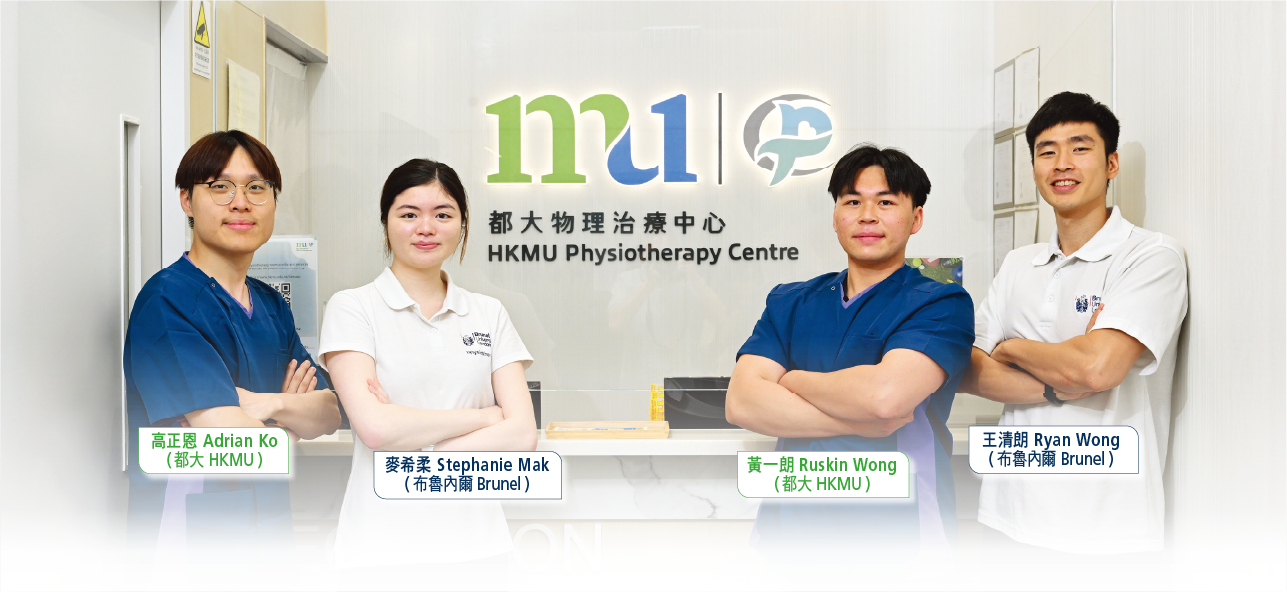
HKMU’s Department of Physiotherapy recently launched a practicum exchange programme with two universities, Brunel University of London in the UK (Brunel) and Haute École de Santé — Vaud (HESAV) in Switzerland. Two HKMU students already spent a month and a half at Brunel from February to March, while two students from Brunel were placed in the HKMU Physiotherapy Centre from late April to late May. In May, the four students met at HKMU to share their experiences and observations.

Brunel students at HKMU

As students at Brunel, Ryan Wong and Stephanie Mak have always been placed in public hospitals for clinical practicum in the UK. Ryan observed that the most significant difference between practicum in the UK and in Hong Kong comes from public hospital versus private clinic settings. “Relatively few people would pay extra for private services because the UK's public health system has wider coverage backed by higher taxes,” he explains. The practicum exchange at HKMU provided the Brunel students with an opportunity to experience working in a private clinic, which is harder to get hold of in the UK.

Comparing the healthcare systems in Hong Kong and the UK, the two students also talked about the UK policy of minimising hospitalisation. “Only medically unfit patients are kept in hospital,” says Ryan. “Otherwise, patients are sent to care homes, nursing homes or back to their own homes, depending on their conditions. In cases of less severe stroke, for example, patients can be discharged in one to two days and then followed up by community physiotherapists.” Stephanie adds that discharged patients are offered a free package of continuing care, “Patients can request home visits by healthcare professionals or care workers several times a day for four to six weeks after discharge.” In general, they are more used to dealing with severe cases in UK hospitals, whereas in the HKMU Physiotherapy Centre, they had more opportunities to work with physically mobile patients because of the population that the Centre serves.

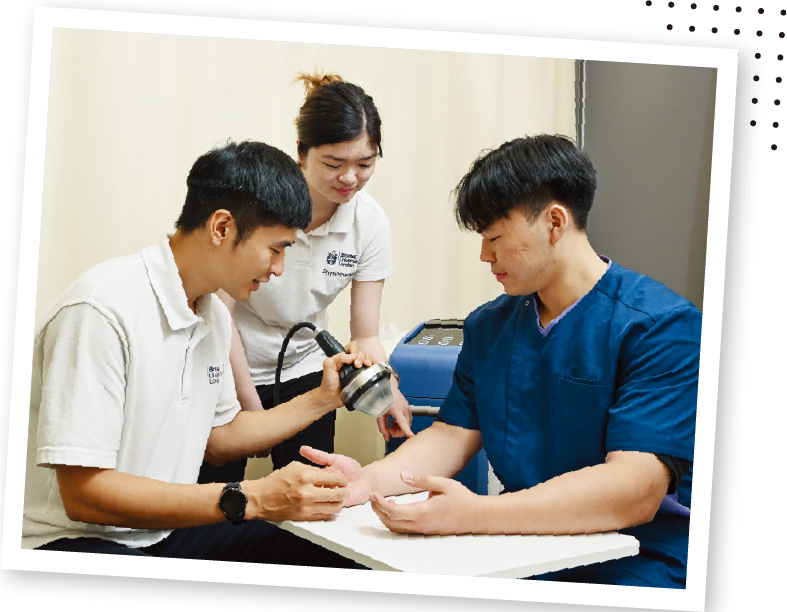
The students also learnt new practical skills at the HKMU Physiotherapy Centre. Patients in Hong Kong would likely be surprised by how rarely electro-physiotherapy is called for in the UK. “Especially in public hospitals,” says Ryan, “I've only seen shockwave therapy machines being used.” Instead, physiotherapy sessions in the UK are heavily focused on exercise prescription, with at least two to three exercises prescribed at every consultation. As Stephanie explains, “the rationale is to enable patients to keep working at home without the aid of sophisticated instruments.” At this, HKMU student Adrian Ko Ching-yan remarks, “This may not work in Hong Kong — if you simply ask patients to do exercise, they may not follow. You have to motivate them with some immediate relief.” Because of this cultural difference, the application of electro-physiotherapy is no longer a staple in UK physiotherapy curricula. “We only learnt to operate the modalities here,” says Ryan. Adapting to the different physiotherapy practice in Hong Kong, both Brunel students quickly mastered the theories and skills of electro-physiotherapy and applied appropriate modalities to relieve patients' conditions.

In addition, Ryan and Stephanie benefitted from participation in home visits, exercise assessments for a cancer centre, and in-service training for a private hospital along with HKMU physiotherapy students. “In particular, the home visits inspired me to consider patients' needs beyond their physical conditions, such as their living environment, so that we could work out how best to help them. An example was that some people living alone could hardly manage on their own,” Stephanie notes.

HKMU students at Brunel 

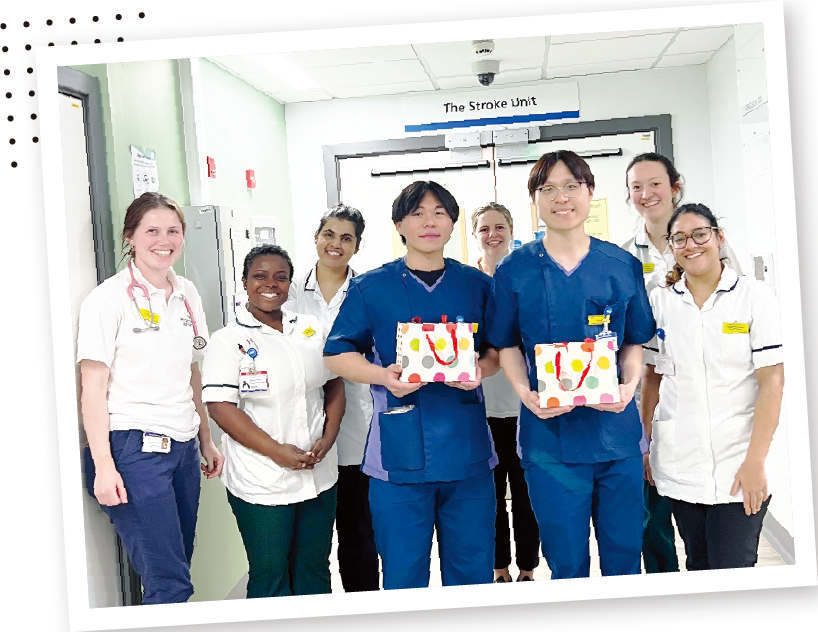
Speaking of exercise prescription, HKMU students Ruskin Wong Yat-long and Adrian Ko Ching-yan recalled attaching to a weekly exercise class at Brunel for people recovering from stroke, in which they joined local students in taking turns to lead the exercises. “It was a very nice experience. I think the exercise class is a good platform for students to test out their exercise prescription skills,” Ruskin says. “The class has really good vibes too, as most of the attendees were recruited from the neighbourhood and they have been attending the classes regularly for so long that they have become friends.”

In London, Ruskin and Adrian attended classes at Brunel in the first two weeks before starting their clinical practicum in a public hospital. For them, the most eye-opening experience was observing on-field physiotherapy provided by Brunel's physiotherapist for a rugby team associated with the University. While they do have opportunities to support sports teams at HKMU, Ruskin noticed a significant difference in scale. “The team associated with Brunel plays at the elite level, and their training is very systematic. The physiotherapist tracks each player's progress to help them optimise their performance,” he remarked.

While the students noticed little difference in the fundamental knowledge they are taught, they point out a significant difference in the mode of knowledge delivery. The HKMU students speak about how classes in Brunel are reserved exclusively for practical training, and students are expected to self-study lecture materials beforehand. “I learnt to be more proactive because if you don't ask, nobody knows you have questions,” says Ruskin. Stephanie from Brunel responds that this practice was adopted during and after Covid-19, “I actually find it quite nice to be able to absorb knowledge in my own quiet space and pace.” The other interviewees agree.

Adrian says “One thing I learnt from local students at Brunel is not to shy away from making mistakes. They're very outspoken and aren't afraid to voice their thoughts.” This is echoed by Stephanie, who also grew up in Hong Kong and has been learning the same lesson since studying in the UK.

Latest incoming exchange student from Switzerland

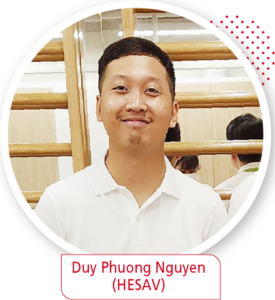
Then in mid-June, we welcomed Duy Phuong Nguyen, a Swiss-born Vietnamese student from HESAV, who was staying until early August. He shared with us his first impressions of his exchange experience at HKMU.

Q: How was life in your first two weeks in Hong Kong?

A: Over the past two weeks, my life in Hong Kong as an exchange student from Switzerland was an incredible adventure. This city is absolutely stunning! I’ve rented a cozy studio in a charming neighborhood near Mong Kok, which is perfect for settling in. The area is vibrant yet peaceful, with great spots for jogging and accessible markets offering delicious local food, from dim sum to noodle dishes, for me to eat well.

Getting around Hong Kong has been surprisingly smooth. The public transport system, especially the MTR, is so efficient, and much more convenient and user-friendly than I expected.

I’m excited to keep exploring this city and making the most of my exchange experience!

Q: What are the differences in clinical practicum between Switzerland and Hong Kong?

A: I’ve found clinical practicum fundamentally similar between Switzerland and Hong Kong, as the core of the physiotherapy profession remains consistent. However, I’m thrilled to be learning new knowledge and techniques I wasn’t exposed to or didn’t master in Switzerland. For example, I attended a course on electro-physiotherapy, which strengthened my understanding and skills. There are minor differences, such as working hours, language barriers and session durations, but these don’t feel significant. Overall, the similarities outweigh the differences, and the opportunity to expand my knowledge with new approaches has been incredibly rewarding, making my time in Hong Kong both educational and exciting.

Q: What is the most interesting or memorable part of your attachment to community services organised by NGOs?

A: Visiting the short-stay home in Kennedy Town and providing the exercise class for cancer survivors in Tuen Mun were profoundly enriching, from both the human and physiotherapy perspectives. I was surprised to notice instantly the similarities with practices in Switzerland. It was remarkable to see familiar approaches to patient care and rehabilitation being applied so seamlessly. The most memorable aspect was the extremely advanced and precise modalities used for various rehabilitation processes. These modalities enhance the effectiveness of therapies, making a tangible difference in patient outcomes.