



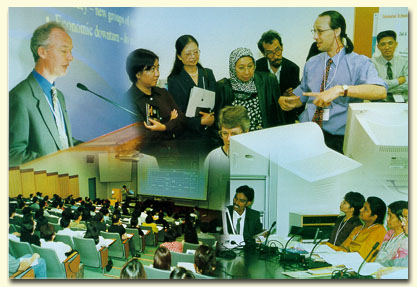

In October 1997 the Government provided the University with a one-off grant of $50 million to develop itself into a Centre of Excellence in Distance and Adult Learning. In connection with this, the University's academic units and the Educational Technology and Publishing Unit (ETPU) started to implement a number of projects.
Some teaching and learning initiatives, such as the use of the Internet and multimedia elements in course delivery, the production of a number of CD-ROMs to supplement the print-based course materials and the use of communication technologies in distance teaching, were put into practice. Courses and assessment methodologies for language enhancement were developed and Chinese language course materials were produced for about 20 courses.
The University also strived to promote best practice through advice and consultancy in distance education instructional design, teaching methodologies and pedagogy, especially in the mainland and the Southeast Asia region. Three workshops in instructional design were organized by the ETPU for distance education practitioners both within and outside the OUHK.
On the other hand, continuous efforts were made to secure proper funding from the Research Grants Council of the Government's University Grants Committee for research projects conducted by OUHK academics.
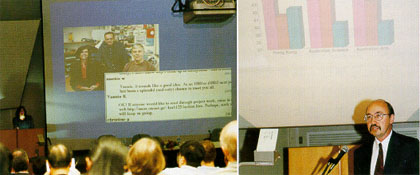 |
| The OUHK hopes to organize more exchange activities between distance and adult learning educators. |
Centre for Research in Distance and Adult Learning
The establishment of a research centre by the University in 1997 was a major thrust towards the goal of becoming a Centre of Excellence in Distance and Adult Learning.
The Centre for Research in Distance and Adult Learning (CRIDAL) spent the most part of its first year on staffing, infrastructure development, networking and understanding the local, regional and international academic and professional environment - culminating in a strategic plan for its future endeavours. As a result, it was able to embark on a number of activities and research projects of significance to the OUHK and local and regional communities.
As a first priority, professional development workshops were organized to provide University staff with the necessary skills and knowledge in distance and adult education research methodology. Soon after its establishment the CRIDAL was selected by the World Bank as its East Asia regional site for the Global Distance Education network. This CRIDAL-managed East Asia Net was demonstrated as a showcase at the 1998 World Bank General Conference. In addition, the CRIDAL successfully hosted the first ever video-conference session in Hong Kong on distance education at the 1998 Hong Kong Educational Research Association Conference, with participants at four sites in Hong Kong, Australia, the USA and India being linked electronically.
The first electronic meeting of the CRIDAL's International Advisory Board (IAB) took place from 31 July to 7 August 1998. Valuable feedback was given about the CRIDAL's current projects, and some worthwhile discussion ensued about future distance education research needs at the OUHK, in the Asia Pacific region and on a global scale. The IAB is composed of distinguished academics, researchers and managers from academia, industry and international organizations in Hong Kong and around the world. Such meetings will be conducted twice a year on the Internet.
During the year significant progress was made on four CRIDAL projects. They were:
- Factors that enhance achievement in open learning: a case study of high-versus-low-achieving students at the OUHK;
- A comparative study of the administrative styles, educational processes, and outcomes of selected Asian open universities;
- Learning about learning: a focus on problem-based learning in distance education;
- A database of experts and their expertise in distance/adult education: an Asian inventory.
These projects were aimed at enhancing the skills of OUHK staff interested in learning about research methodology, so that the Schools and the CRIDAL can co-operatively develop a critical mass of distance education researchers at the OUHK. A cohort of interested OUHK staff nominated through their Deans participated in each of these projects.
In order to investigate if distance education and, specifically, the OUHK can meet the professional employment requirements of employers and OUHK students and graduates in Hong Kong, the CRIDAL and the Public Affairs Unit jointly conducted a research project, 'Employer and student perceptions of the OUHK'. Altogether, 2,560 graduate/student questionnaires and 488 employer questionnaires were returned. The results were being analyzed to understand the role played by the OUHK in improving the quality of Hong Kong's workforce.
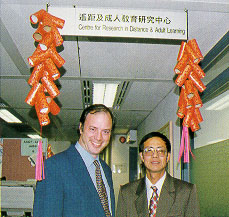 | Visiting scholars Prof. Glenn Shive (left) and Prof. Chen Jianguo conducted research projects with OUHK academics. |
During the year the CRIDAL received about 30 visiting scholars from the mainland and overseas, many of whom delivered talks on distance and adult learning at the OUHK. Among these was Prof. Chen Jianguo of the College of Continuing Education at the East China Normal University in Shanghai, who was granted a visitorship of $120,000 by the Croucher Foundation to carry out research on the inter-relationship between culture, science and distance education at the OUHK for six months. Prof. Glenn Shive, Fulbright Scholar and Director of Research and Development at the Hong Kong-America Centre, collaborated with the CRIDAL to conduct research on the development of distance education in Asia beyond the year 2000.
Research and scholarship activities
The research and development budget for 1998/99 increased by 40 per cent to $13 million. Competitive bids for the Research and Development Fund are considered by the President's Advisory Committee on Research and Development which meets twice a year to consider applications and monitor the progress of on-going projects. A total of seven new project proposals on discipline-specific studies and distance and adult learning were approved by the Committee. Another 12 projects were supported under the School Research Grant Scheme.
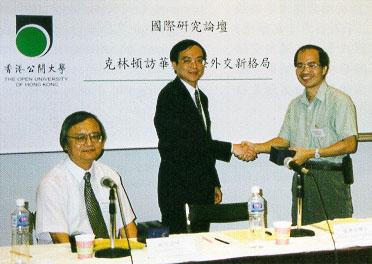 |
| The seminar on 'Clinton's visit to China and the new international order'. |
The Schools and Centres continued to organize various academic activities for both the staff and the general public. Significant events included a seminar organized by the School of Science and Technology on waste water treatment by a Swedish expert on chemical treatment systems in June 1998, and an International Studies seminar hosted by the School of Arts and Social Sciences on 'Clinton's visit to China and the new international order' in July 1998.
| Project Title | Principal Investigators |
|
Learning about learning : A focus on problem-based learning in distance education - second cycle |
Dr Margaret Taplin |
|
Learning activities, ageing and expertise, and metacognitive knowledge of older adults in Hong Kong |
Prof. Olugbemiro Jegede |
|
Language competence vs language demand in study: |
Dr Anita Poon |
|
A discourse analysis in distance learning materials for teacher education |
Dr Leung Yin-bing |
|
Job stress of nurses working in primary care settings |
Mr Joseph Lee |
|
Breast self-examination as an illness prevention practice |
Mr Michael Wong |
|
The development of a multimedia authoring environment for web-based learning |
Dr Reggie Kwan (School of Science and Technology) |
Table 2 : New projects supported by the School Research Grant
| Project Title | Principal Investigators |
|
Measuring the economic linkages within the Greater China Bloc with stock market data |
Dr Lo Wai-chung |
|
Employees' perceptions of corporate values and norms |
Dr Cheuk Wai-hing |
|
A review of the development of adult education in Hong Kong: 1988-1998 |
Mr Chan Shui-kin |
|
A survey on OUHK students and their potential employers' perceptions of English language competence in Hong Kong |
Dr Anita Poon and Mr Thomas Tang |
|
Supporting collaborative learning through online discussion - a case study of an 'Educational Management in Action' course offered by the School of Educationand Languages of the Open University of Hong Kong |
Mr Ng Kwok-chi |
|
A survey on the attitudes of OUHK students towards the establishment of the Hong Kong General Teaching Council |
Ms Yu Wai-bing |
|
Women teachers in distance learning programmes |
Dr Yvonne Fung |
|
Pilot investigation into turnaround of tutor-marked assignment |
Dr Rocky Fan and Dr Michael Robertshaw |
|
Modelling tutor-marked assignment turnaround |
Dr Rocky Fan and Dr Michael Robertshawacross the university |
|
Bid-ask spreads determinants: Cross-sectional analysis in the Hong Kong market |
Mr Raymond Lee |
|
Trainers' perception on workplace adoption of open and distance learning as a strategy of human resource development in Hong Kong: A follow-up study |
Mrs Susan Ha |
|
The effectiveness of learning skills for adults |
Ms Annie Lee |
You are welcome to make your comments and enquiries by
Copyright 1999 The Open University of Hong Kong
sending email message to pau@ouhk.edu.hk