



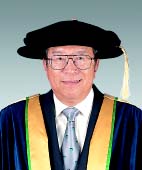
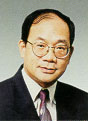
Mr Charles Lee Yeh-Kwong, Council Chairman |
I was honoured to become Council Chairman of the Open University of Hong Kong (OUHK) in July 1998, and to have the opportunity of working for the advancement of higher education in Hong Kong in a university which has attained remarkable growth and stature in recent years.
In his Policy Address in October 1998, the Chief Executive of the Hong Kong Special Administrative Region, the Honourable Tung Chee Hwa, noted that the OUHK was leading the way in developing Hong Kong as a learning-based community. This is a considerable achievement for an institution which has a short history of only nine years. This recognition of our work has given the University an added impetus for further enhancement of its performance in the future.
As we enter the new millennium and the age of information, education assumes fundamental importance as a social and economic investment. Hong Kong's future in the next century depends on whether we can evolve into an enlightened, knowledge-based society and enhance our competitiveness. We need to develop a workforce which recognizes the importance of life-long learning and is eager to enrich its skills and potential. This mission is especially pressing as Hong Kong faces unprecedented challenges and an arduous restructuring of its economy.
As the OUHK was founded on the vision of life-long learning and education for all, it can make a significant contribution to upgrading the quality of Hong Kong's workforce and promoting a change in attitude towards continuing education. Many of our graduates and students have successfully applied their learning to their work. Their enhanced academic qualifications have enabled them to move up the career ladder or change career paths. A number of our graduates have also embraced learning as a life-long process and obtained their second or even third degree here.
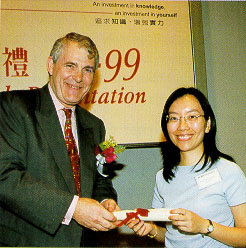 |
Mr David Eldon, Chairman of the Hongkong and Shanghai Banking Corporation Limited, presents the OUHK Scholarship to student Miss Alice Chan. The Hongkong Bank Foundation has been a major donor of bursary grants to the OUHK since 1994. |
The vote of confidence in the OUHK is not limited to students and graduates. Many employers have joined our Employer Support Scholarship Scheme and are giving financial support to their staff to attend the University. Other donors and philanthropic bodies have also demonstrated their support through substantial donations and sponsorships for our projects. In particular, I would like to thank the Hong Kong Jockey Club Charities Trust for pledging a donation of $10 million towards our Multimedia Laboratory and the Croucher Foundation for converting its previously pledged loan of $5 million into a donation towards the Electronic Library during the year.
 |
 |
 |
 |
 |
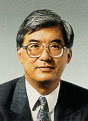
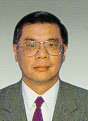
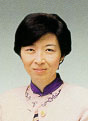
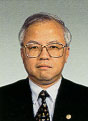
| Mr Philip Chok Kin-fun | Mr Stanley Ko | Mrs Fanny Law | Mr Peter Lee Shung-tak | Dr Lo Wai-chung |
On behalf of the OUHK, I would also like to express our deep gratitude to Council members of the University who have departed in 1998 after many years of dedicated service, notably my predecessor Mr Peter Wong Hong-yuen, who had been with us since 1989 and led the University successfully through many challenging tasks. Others include Mr Matthew Cheung Kin-chung, Dr Peter Dirr, Dr So Wai-chor, Dr Tam Man-kwan and Mrs Helen Yu Lai Ching-ping. In their places I would like to welcome Mr Philip Chok Kin-fun, Mr Stanley Ko Kam-chuen, Mrs Fanny Law, Mr Peter Lee Shung-tak and Dr Lo Wai-chung.
Credit should also go to the OUHK's academic and administrative staff whose dedicated efforts have enabled the University to progress to its present position. Unlike other local tertiary institutions which operate principally on direct funding from the Government, the OUHK has been self-financing for many years and has thrived on an entrepreneurial spirit. Efficiency and cost-effectiveness have always been essential for our survival and a performance-related pay scheme has been implemented by the University since 1997.
The Council and academic and administrative staff of the OUHK are committed to pursuing vigorously our mission of serving the educational needs of Hong Kong in our second decade of development, and to further strengthening the University's leading position in the Asia Pacific region as a Centre of Excellence in distance and adult learning.
Charles Lee Yeh-kwong,

Council Chairman
June 1999
You are welcome to make your comments and enquiries by
Copyright 1999 The Open University of Hong Kong
sending email message to pau@ouhk.edu.hk