By the time I retire later this year, I will have served at the OUHK for over eight years. Looking back, I feel honoured to have contributed towards the growth of this young institution and its mission of 'Education for All' during its formative years. I am also glad to see increasing recognition of and support for open and distance education in general – and the OUHK in particular – from both the international and local communities.

Since 1995 when I assumed duty as the President, the University has moved forward in a number of areas. We made history when we became the first local institution to attain university status in less than eight years. In terms of growth, the figures speak for themselves. For example, the number of our graduates has increased more than ten-fold. The number of Hong Kong students taking courses in a semester reached a high of 26,875 in 2001, while our students in Mainland China increased from 141 in 1997 to about 3,000 at present. The number of programmes has nearly tripled, with more postgraduate programmes being offered. There are also more courses, both in absolute number and in Chinese medium.

 
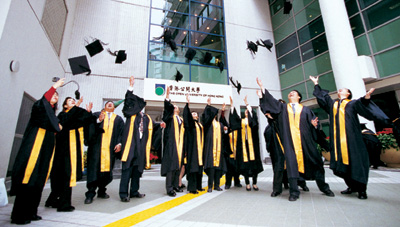
The number of OUHK graduates has increased more than ten-fold over the last few years.


As regards research and academic activities, we established the Centre for Research in Distance and Adult Learning and received funding from the Government for the first time for three research proposals recommended by the Research Grants Council. The international status of the OUHK was enhanced by our holding of a three-year presidency of the Asian Association of Open Universities and hosting of a number of large-scale conferences. We won institutional awards from the Commonwealth of Learning and the International Council for Open and Distance Education, as well as international and local prizes for our electronic library, website and Information Centre, and for our marketing work and service quality.

Student support services have been strengthened with our relocation from a commercial building at Mong Kok to a dedicated campus at Ho Man Tin and the establishment of the Island Learning Centre at Sheung Wan; the setting up of an e-text centre; the launching of the IT Plan and online courses; and the availability of more financial assistance. We achieved all this while our finances were in good standing with a recurrent surplus nearly every year.

Here I would like to pay tribute to the many people who have contributed in one way or another to helping the OUHK arrive at where it is today. I am particularly grateful to a number of Council members I have worked with: Chairmen Mr Peter Wong and Mr Charles Lee, Vice Chairmen Mr Carlos Cheung, Dr Philip Wu and Mr Stanley Ko, Treasurers Mr Eric Li and Mr David Sun, and other members including Miss Gladys Li and Mr Edward Cheung. The current success of the OUHK owes much to their guidance and support and to the other Council members who helped us lay a firm foundation for future development.

I must also thank our students, alumni, staff and supporters from various sectors of society. Without their support, hard work and encouragement, the OUHK would not have been able to confront its many challenges and still produce excellent results.


As for the year under review, you can read the details of the University's major achievements in the 'Highlights' pages. Here I would like to draw your attention to the Government's blueprint for the further development of higher education in Hong Kong issued in November 2002. A number of new policies contained in the blueprint will have a long term impact on the OUHK.

Most importantly, the University Grants Committee (UGC) will become responsible for co-ordinating the development of the degree sector, including the OUHK, while the Manpower Development Committee will oversee sub-degree programmes. As a result the UGC will, without extending its funding ambit, conduct periodic audits on the OUHK as well as the institutions it funds.

In our responses to the various consultative documents submitted to the Government and in our everyday work, the OUHK has been advocating for years many of the policies announced in the blueprint. Among them was the proposal for a central body to co-ordinate higher education in both the conventional and continuing streams, with a flexible credit system providing a link between them. We therefore welcome the decision to put the University under the aegis of the UGC for the quality assurance of our degree-level work. A small group chaired by Prof. Danny Wong, Vice President (Academic), has been appointed to liaise with the UGC to handle issues related to the transition.


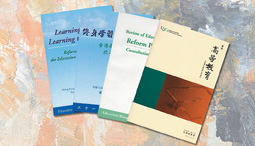
The OUHK has made a number of responses to the Government's consultative documents on the development of education.


We are also glad to see the introduction of a comprehensive qualifications framework and a universal Credit Accumulation and Transfer System across tertiary institutions. However, such a system should not be restricted to the present eight UGC-funded institutions but also include institutions such as the OUHK if it is to be truly comprehensive. We hope the Government will look into our long established credit transfer system before it comes up with a system applicable to all institutions in Hong Kong.

I am sure the new President, Prof. John Leong, will continue to fight for the rights and interests of OUHK students as well as for more support from the Government, especially for funding the Phase Two construction of our campus. Anyone who has visited our Ho Man Tin campus will have noticed how congested it is; our students often complain about the lack of space for discussions and activities, and our staff are working in a very cramped environment.

Another unfulfilled wish of mine is to reduce our tuition fees from the current level so that more adults in Hong Kong can benefit from the OUHK's flexible mode of education. This could be achieved if the Government is willing to finance part of our recurrent expenditure. Nearly all open universities around the world receive subsidies from their governments, who are keenly aware that they are making a wise investment in the human resources of their communities. By adopting the 'users pay' principle and leaving the OUHK in a financial straitjacket, the Government is limiting the growth of the University and restricting the contribution continuing education can make towards our society.


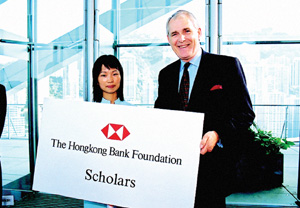
The Hongkong Bank Foundation has donated bursary awards to the OUHK's needy students since 1994. OUHK student Ms So Kwan is pictured here with Mr David Eldon, HSBC Chairman, at the Foundation's annual tea reception.


The OUHK has already put into operation its Business Plan for 2003 to 2006. We intend to develop courses of shorter duration, and more programmes at postgraduate level and in the Chinese medium and in IT, as well as for associate degree graduates. One of the most significant new IT initiatives will be the setting up of a Centre for Innovation that aims to apply innovative technologies in teaching, learning, research and administration. We will also keep up our research efforts and work steadfastly towards our goal of becoming a regional Centre of Excellence in distance and adult learning.

With a strong commitment to efficiency, a very flexible set-up and prudent financial management, the OUHK has over the years crossed one milestone after another. In spite of the uncertain economic outlook, I believe the University is well positioned to take on new challenges and will have a bright future.


Prof. Tam Sheung-wai
President
June 2003


2002-2003 OUHK Annual report