As a self-financing institution, the OUHK, unlike Hong Kong's other universities, has received no subvention towards its operating cost from the Government since 1993. It has to rely on tuition fee income for over 90 per cent of its recurrent expenditure. However, there have been ad hoc Government grants and donations from private and corporate donors for various capital expenditure projects as well as scholarships and other financial assistance for students.

The University has been able to maintain a healthy financial position through stringent cost control. Prudent financial management allowed it to record a net surplus of $5 million with a high degree of liquidity for the year. The surplus was transferred to the General Reserve for unforeseeable financial difficulties.

Income and expenditure account
However, the persistent economic woes and high unemployment have taken their toll. The year recorded a drop in student enrolment, and as a result an income reduction of 4.3 per cent over the previous year. To alleviate the burden on students and encourage more people to pursue lifelong learning, the University decided to continue the tuition fee discount scheme first introduced in April 2002 for the October 2002 and April 2003 semesters.

The total operating income fell by 4.6 per cent to $499.4 million. The total operating expenditure was $490.9 million, representing 2.8 per cent less than the previous year. A total of $3.6 million was incurred on capital development projects, in particular for purchasing equipment in the science laboratories.


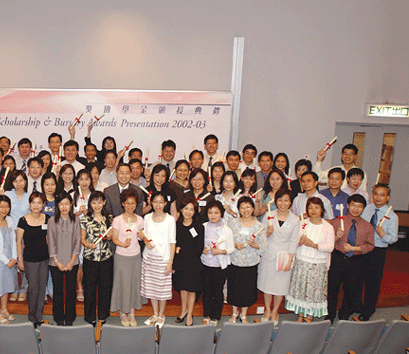
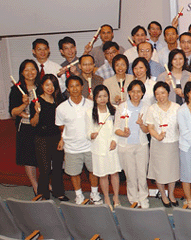
More than $2.8 million in scholarships and bursaries was disbursed at the OUHK's 2002-2003 Scholarship and Bursary Awards Presentation, up 40 per cent from the previous year and a record high since the awards became available.


Donations
Besides a donation of $15 million by the Hong Kong Jockey Club Charities Trust in support of the University's 2000-2002 Information Technology Development Plan, a total of $11.3 million was received from various philanthropists, corporations and charitable foundations, mainly for helping needy students.

Interest and investment income
Interest and investment income on the working capital fund for the year totaled $5.2 million, as compared with $10.2 million in the previous year. In view of the continuing drop in interest rates for fixed term deposits, the University decided to use part of the fund to buy certificates of deposit for a higher yield.

Retirement schemes
Various retirement schemes, including one devised in compliance with the Occupational Retirement Schemes Ordinance (ORSO), have been provided to staff. A total of 502 staff members were in the ORSO scheme with a fund size of $113.9 million at the year end. Due to the poor investment climate, the six investment funds under the scheme recorded a return ranging from -15.9 to five per cent. The Mandatory Provident Fund scheme set up for temporary and part-time staff had 1,226 members and a fund size of $11.8 million. Its six investment funds recorded a return ranging from -19.9 to 2.9 per cent.

Reserves
The balance of the reserves at the end of the year was $345.6 million, as compared with $341.2 million in the previous year. The University will continue to build up its reserves for unforeseeable needs in the future.

Mainland activities
The Open University of Hong Kong (China) Limited, a subsidiary of the University responsible for managing Mainland activities, recorded a profit after tax of $4.6 million for the year 2002, representing an increase of 22.5 per cent over the previous year. Total service income rose by 24.8 per cent to $10.7 million. The Company's subsidiary has declared a final dividend of $2.5 million, as compared with $700,000 in 2001, after year-end-closing and would distribute it to the Company upon tax clearance in the Mainland. About half of the new office of the Company's subsidiary in SEG Plaza has been rented out to three overseas-based companies for two years.

Outlook
In view of the unfavourable economic situation, the University forecasts a further reduction in income due to decreased enrolment in the future. It will step up cost control measures to enhance productivity while maintaining the quality of courses and services to cope with this challenge.

 
  OUHK makes efficient use of limited resources


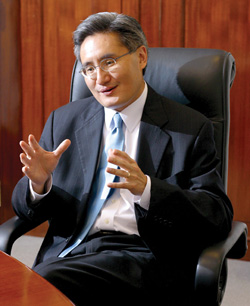
David Sun, a partner of the accounting firm Ernst & Young, became a member of the OUHK Council in 1994 and took up the post of treasurer in 1996. Back then the OUHK had just stopped receiving financial support from the Government and become self-financing, with deficits recorded in its balance sheet for a number of years. The efforts of Mr Sun and members of the Council's Finance Committee eventually bore fruit as there had been small surpluses starting from 1997. 'We had a hard time in thinking up ways of cutting costs and improving efficiency. Fortunately student numbers were on the rise then, so there was more tuition income,' he said.

'Although the OUHK is self-financing, our prudent financial management has allowed us to achieve a higher value for money in terms of a number of performance indexes compared with Government-financed institutions, as in the case of our lower direct cost per student,' he said.


With the economy now in the doldrums, fewer people are enrolling in courses. At the same time, there are more and more continuing education institutions. As competition has become more intense, Mr Sun forecasted that the University's books might go into the red again next year.

In view of the uncertain economic outlook, Mr Sun said the OUHK must cut costs and find new sources of income. 'But providing education is not the same as running a business. We must not compromise our teaching quality for the sake of balancing the books.' The University would consider running more face-to-face, online and Mainland courses to meet market needs, and review staff's pay packages since they account for most of its direct costs, according to Mr Sun.

Mr Sun enjoys jogging, reading and listening to western classical music during his spare time. He also devotes much of his time to community work and was elected President of the Hong Kong Society of Accountants early this year.


2002-2003 OUHK Annual report